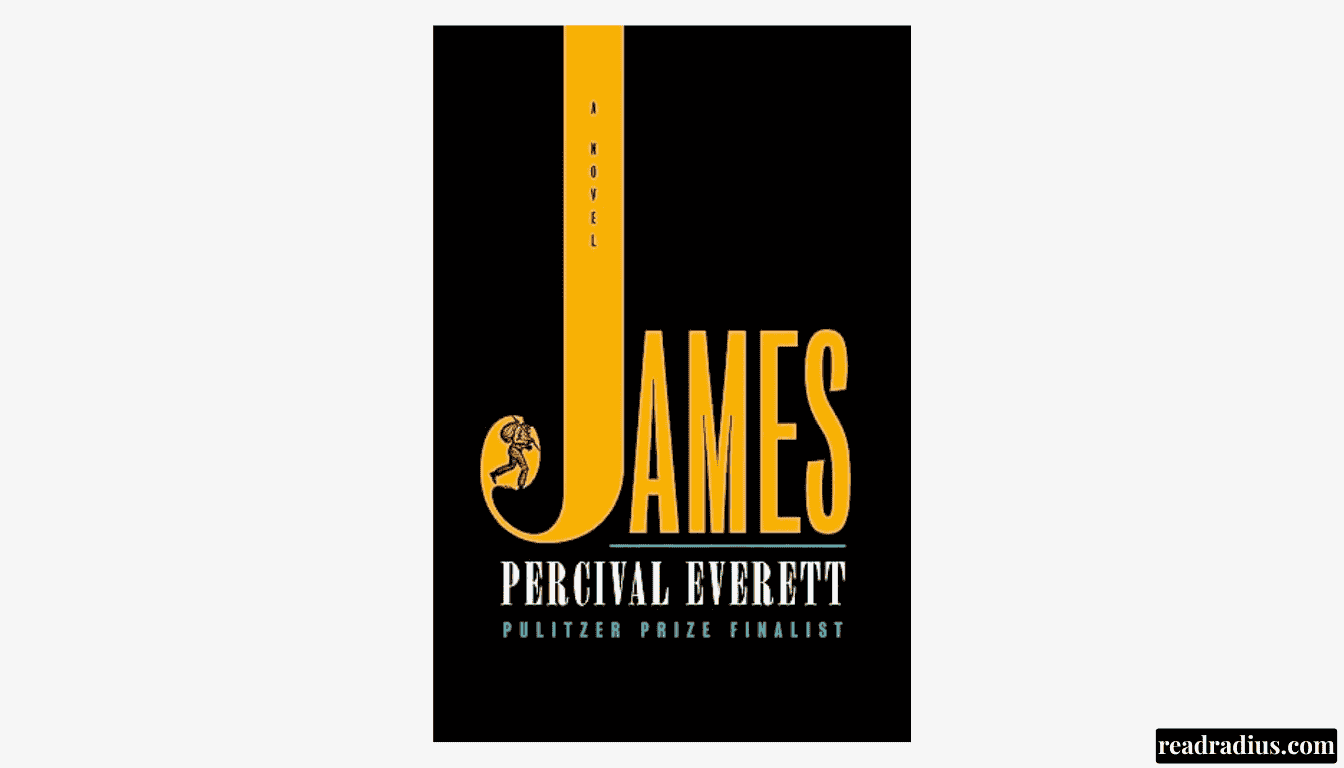
There’s a particular kind of book that changes how you read everything that came before it and for a lot of readers, that’s exactly what happened with Percival Everett’s James.
If the title, the cover, or the buzz around book clubs and dinner tables has put James on your radar, this review covers what the book delivers, how it’s been received, what happens by the end, and where to go next if you want to think about it more.
What James Is About
Published in 2024, James takes Mark Twain’s Adventures of Huckleberry Finn and flips the camera around. Instead of following Huck, the novel is narrated by Jim the enslaved man Huck travels with down the Mississippi who reveals himself to the reader as James: articulate, calculating, and quietly furious at a world that refuses to see him as a full person.
What makes the novel stand apart isn’t just the premise, clever as it is it’s the execution. Everett gives James a private language: a code-switching fluency that lets him play “safe” and simple around white characters while thinking in precise, often devastating prose the moment he’s alone or among people he trusts. Watching those shifts happen in real time is one of the more striking things about the book, and it’s a large part of why it swept the National Book Award, the Kirkus Prize, and the Pulitzer Prize for Fiction.
The novel earns its praise less through plot twists than through mood. There’s a simmering tension on nearly every page a sense that James is always performing, always calculating his next move, even in scenes that look, on the surface, like a classic riverboat adventure. That tension is what carries readers through even the quieter stretches.
Plot Summary (Spoiler-Light)
Here’s a broad shape of how the story unfolds useful for a refresher before a book club meeting or class discussion, without spoiling every turn:
- Opening chapters: James, enslaved by Miss Watson, overhears that he’s about to be sold and separated from his wife and daughter. He flees to Jackson Island, where he crosses paths with Huck Finn, who has faked his own death to escape his abusive father.
- Early river chapters: James and Huck begin traveling together, and readers get their first glimpses of James’s hidden interior life his literacy, his private journal, the deliberate performance he puts on for white people.
- Middle chapters: The pair are separated and reunited multiple times, encountering con men, violence, and moral tests that mirror and often subvert the original Twain plot. James’s backstory deepens, including his relationships with other enslaved characters who share his hidden intelligence.
- Later chapters: The stakes rise sharply as James is captured, sold, and forced into increasingly dangerous situations, all while trying to find his way back to his family.
- Final chapters: The novel builds to a confrontation that reframes everything readers thought they understood about James’s relationship with Huck, and with the truth.
How the Ending Lands
The ending is where the novel fully breaks from Twain’s original and asserts itself as its own story. Without giving away the final pages, it forces a reckoning: James stops performing safety for anyone white or Black and takes direct action to secure freedom for himself and his family. It trades Twain’s comic resolution for something closer to reclamation: less “the adventure wraps up neatly” and more “a man finally gets to write his own ending.”
Readers expecting a straightforward companion piece to Huckleberry Finn are often surprised by how far the final chapters diverge and that divergence is intentional. Everett has said in interviews that his goal was never to correct Twain, but to give James a story of his own, and the ending is where that intention becomes unmistakable.
Critical Reception
James was one of the most decorated novels of 2024, and critical response has been strongly positive across the major outlets that cover literary fiction praise has centered on Everett’s handling of voice, the moral complexity he gives James, and the way the novel forces a re-read of Twain’s original. It’s worth reading a couple of full reviews yourself if you want the specifics; The Guardian and NPR both published in-depth pieces around the book’s release that dig into how Everett reworks Jim’s character specifically.
Where the Novel Draws Criticism
Not every reader has walked away convinced, and it’s worth being upfront about that. Some criticism centers on a specific complaint: that the novel, for all its cleverness, sticks close enough to Twain’s original plot that it can feel more like a shadow of Huckleberry Finn than a fully independent work. Readers who know the source material well sometimes find the parallel structure predictable rather than surprising, since many of the same events occur in roughly the same order.
Other critics have pushed back on tone, describing sections of the book as emotionally flat or overly controlled given the brutality of the subject matter a deliberate choice on Everett’s part, some argue, but one that doesn’t land for every reader. These are minority opinions compared to the overwhelming critical and award consensus, but they’re worth knowing going in, especially for readers hoping for something wholly unrecognizable from Twain’s text.
Beyond the major outlets, reader and book-club reaction tends to circle back to a few consistent points: the audiobook narration is frequently singled out as exceptional, the dual-language conceit the “safe” dialect versus James’s private voice is almost universally praised, and readers who pair the book with a reread of Huckleberry Finn often report a richer experience than those who read James on its own. The most common critique in reader reviews is pacing in the middle third, more than the writing itself.
Discussion Questions for Book Clubs and Classrooms
- How does James’s dual voice the dialect he performs for white characters versus his internal narration change the way readers understand agency and survival under slavery?
- Does the novel succeed in giving Jim/James a story separate from Huck’s, or does it remain tethered to Twain’s structure?
- What does the ending suggest about the difference between freedom that is granted and freedom that is taken?
- How does reading James change your understanding of the original Adventures of Huckleberry Finn, if you’ve read it?
- Everett has said he didn’t intend the novel as a correction of Twain. Do you agree, based on how the book is written?
Final Thoughts
James isn’t a comfortable read, and it isn’t trying to be. What it offers instead is a genuinely new vantage point on a story most American readers think they already know, delivered with sharp humor, real tenderness, and an ending that earns its weight. Whether it’s being read for a class, a book club, or personal curiosity, it rewards close attention its quieter chapters pay off by the final pages.
For readers who enjoyed the historical grounding and reimagined perspective of James, it’s worth exploring more historical fiction that blends real history with inventive storytelling.




Leave a Reply