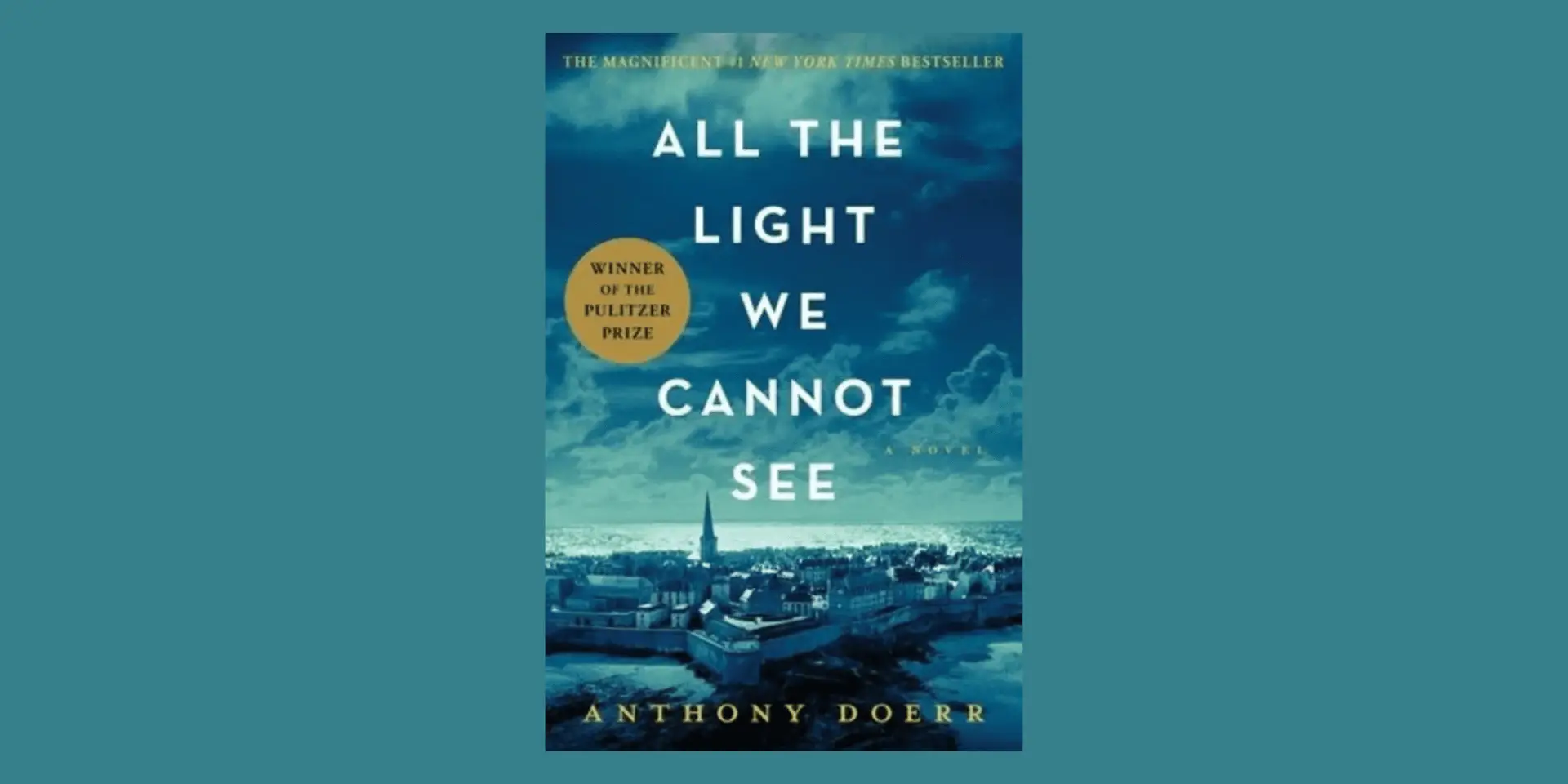
Some novels arrive quietly and leave a permanent mark on the reader’s soul. All the Light We Cannot See by Anthony Doerr is precisely that kind of book. Published in 2014 and winner of the 2015 Pulitzer Prize for Fiction
, this extraordinary novel swept readers off their feet with its lyrical prose, unforgettable characters, and deeply human story set against the brutal backdrop of World War II.
In an era where readers look for stories that explore resilience and moral courage under extreme hardship, this review stands as a reminder of literature’s power to illuminate what is essential in human nature. This article offers a complete book review of All the Light We Cannot See by Anthony Doerr, exploring its plot, characters, themes, length, and global adaptation.
Whether you are a casual reader or a dedicated literary enthusiast, this review will help you decide if this novel deserves a spot on your reading list and the answer is almost certainly yes.
What Is All the Light We Cannot See About?
At its heart, this is a novel about two young people on opposite sides of World War II whose lives are destined to intersect.The story follows Marie-Laure LeBlanc, a blind French girl living with her father in Paris, and Werner Pfennig, a German orphan boy gifted in the art of radio mechanics.Their parallel stories are told in alternating chapters that gradually converge toward a single, fateful meeting in the walled seaside city of Saint-Malo, France.
Marie-Laure’s father works as a master locksmith at the Natural History Museum in Paris and carries with him a priceless gemstone called the Sea of Flames, believed by some to carry a terrible curse.As the German occupation of France advances, father and daughter flee to Saint-Malo to take refuge with her reclusive great-uncle Etienne.Meanwhile, Werner’s extraordinary talent with shortwave radios pulls him into an elite Nazi military academy and eventually into a tracking unit tasked with hunting down resistance broadcasts.
Anthony Doerr weaves these threads with patience and grace, asking the reader not just to witness war, but to experience it through sensory details: the tactile maps carved for a blind girl, the click of lock pins, and the faint crackle of radio waves cutting through the dark.
About Anthony Doerr: The Mind Behind the Novel
Anthony Doerr is an American author born in Cleveland, Ohio, widely regarded as one of the most gifted prose stylists in contemporary literature.Among his body of work, All the Light We Cannot See stands as his most celebrated triumph, earning both the Pulitzer Prize and the Andrew Carnegie Medal for Excellence.
His debut short story collection, The Shell Collector, established his signature voice of quiet observation and natural wonder. His earlier novel, About Grace, and the short story collection Memory Wall also drew critical acclaim for their emotional complexity and focus on human memory.
Doerr spent nearly a decade researching and writing All the Light We Cannot See. That dedication shows on every page in the precise historical accuracy, the tender characterization, and the ambitious structure. In 2021, Doerr released Cloud Cuckoo Land, a sweeping multi-timeline epic spanning ancient Greece, contemporary Idaho, and a future interstellar ship, further cementing his place as a master storyteller.
All the Light We Cannot See: A Full Book Review
Writing Style and Prose Quality
From the very first page, Doerr’s prose reads like poetry in motion. He employs short, luminous chapters many no longer than two pages that create a rapid, cinematic rhythm. His sentences are sensory-rich fragments of light rather than traditional narrative blocks.
Doerr writes blindness not as a disability, but as a heightened form of perception. Readers navigate Saint-Malo through Marie-Laure’s senses: sound, touch, smell, and spatial memory. The result is one of the most immersive reading experiences in modern historical fiction.
Characters That Stay With the Reader
Marie-Laure is a wonderfully rendered protagonist brave, curious, and empathetic without ever feeling idealized. Werner is an equally complex figure, presenting a quiet study of how ordinary, decent people can be swallowed up by total political regimes.
The supporting cast is equally memorable:
- Sergeant Major von Rumpel: The terminally ill Nazi officer obsessed with finding the Sea of Flames.
- Etienne LeBlanc:Marie-Laure’s traumatized, agoraphobic great-uncle who uses his hidden radio transmitter to aid the French Resistance.
- Daniel LeBlanc: Marie-Laure’s devoted father, whose love for his daughter drives the story’s emotional core.
Themes: Light, Darkness, and Moral Choice
The novel explores profound questions about fate versus free will, systemic duty versus moral responsibility, and the persistence of human goodness during systemic horror. The central metaphor—the invisible electromagnetic spectrum of radio waves serves as a constant reminder of the unseen connections between human beings.
For readers interested in how different authors tackle the quiet defiance of civilian resistance during World War II, comparing Doerr’s narrative to Kristin Hannah’s acclaimed novel The Nightingale
offers a powerful look at the distinct ways women and families survived the French occupation.
Is All the Light We Cannot See a Good Book?
The short answer: Absolutely.
The longer answer: It is a literary masterpiece, but readers should understand its pace. This is not a fast-paced military thriller; it is a reflective, character-driven narrative that rewards patient reading.
The novel’s non-linear structure jumps back and forth across a decade-long timeline, but these threads converge in the final chapters with profound emotional payoff. It seamlessly bridges the gap between commercial storytelling and high literary fiction, making it accessible to broad audiences worldwide.
Book Length and Reading Time
- Hardcover / Paperback Page Count: 530 pages (edition dependent)
- Chapter Count: 183 short chapters
- Estimated Reading Time: 10 to 15 hours
Because the chapters are brief, the book moves rapidly. It is ideally suited for both long reading sessions and quick sittings.
Story Overview (No Major Spoilers)
The story opens during the Allied shelling of German-occupied Saint-Malo in August 1944, then shifts backward to trace the childhoods of its two main leads:
- Marie-Laure in Paris:Raised amidst the exhibits of the Museum of Natural History, learning to navigate the world via wooden scale models carved by her father.
- Werner in Zollverein:Growing up in a German coal-mining town, fixing radios, and demonstrating an engineering genius that earns him admission to a specialized Nazi academy.
As war engulfs Europe, Marie-Laure flees to the coast with a secret museum artifact, while Werner is deployed to track illegal radio broadcasts across the frontlines. Their paths inevitably cross in Saint-Malo during the final months of the war.
The Netflix Adaptation: Cast and Critical Reception
In late 2023, Netflix released a four-part limited series adaptation of All the Light We Cannot See
, directed by Shawn Levy (Stranger Things) and written by Steven Knight (Peaky Blinders).
Key Cast
- Aria Mia Lobertias Marie-Laure LeBlanc (a breakthrough performance by a blind actress)
- Louis Hofmann as Werner Pfennig
- Mark Ruffalo as Daniel LeBlanc
- Hugh Laurieas Etienne LeBlanc
- Lars Eidinger as Sergeant Major Reinhold von Rumpel
Critical vs. Audience Reception
The adaptation received mixed reviews from television critics (holding a mid-range score on Rotten Tomatoes), who praised its visual direction and authentic casting but noted that condensing a 500-page book into four hours sacrificed some of Doerr’s internal prose depth. However, global audience ratings were significantly warmer, celebrating its cinematic score by James Newton Howard and emotional performances.
Why Readers Around the World Love This Novel
The global appeal of All the Light We Cannot See rests on its universal human themes: love, survival, responsibility, and the struggle to protect beauty in times of destruction.
Alongside real-life historical survival accounts like Heather Morris’s The Tattooist of Auschwitz
, Doerr’s novel stands out as an essential work of 20th-century historical fiction offering hope without glossing over the tragic realities of war.
Final Verdict: Should You Read It?
All the Light We Cannot See fully deserves its Pulitzer Prize and its place among the defining novels of the 21st century. Anthony Doerr has crafted a rare war story—one that avoids celebrating combat and instead highlights the stubborn persistence of human empathy.
Whether you purchase a copy from your local independent bookstore, order it online, or borrow it from a public library, this novel promises a deeply rewarding journey.
Pick it up, read it slowly, and let it stay with you long after the final page.




Leave a Reply