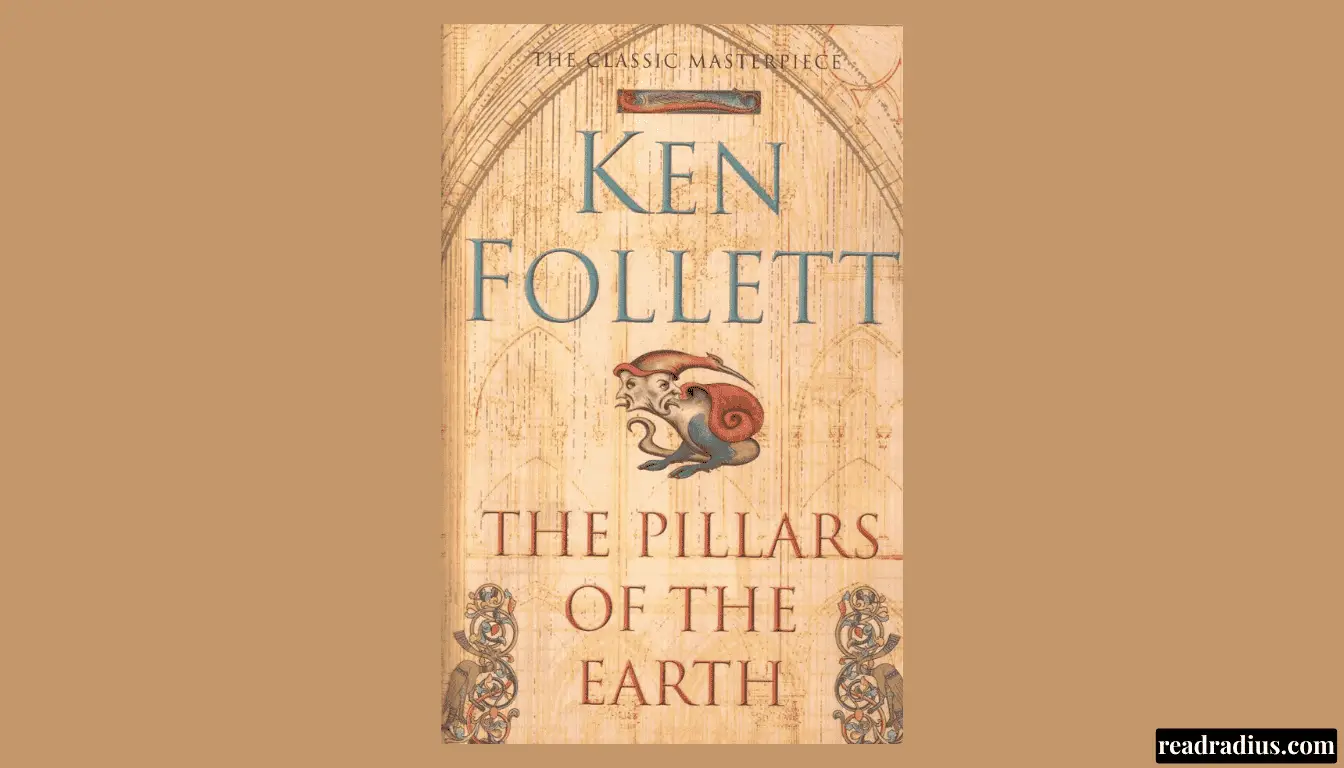
Ken Follett was a spy novelist when he wrote The Pillars of the Earth. He’d made his name on Eye of the Needle tight, fast, 300 pages. Then he spent three years on a 973-page book about masons. His publisher was nervous. It became the book he’s known for.
That gamble is the whole story of this novel. The Pillars of the Earth works because Follett refused to slow down just because he’d gone historical. Chapters still end on cliffhangers. Villains still get their comeuppance in the last fifty pages. The only difference is that the stakes are a cathedral instead of a U-boat.
What Is The Pillars of the Earth About?
A monk named Philip wants to build a cathedral in Kingsbridge. A builder named Tom wants to build it. A woman named Ellen wants to keep her son alive. A bishop named Waleran wants all three of them dead or ruined.
That’s the engine. Around it, Follett stacks roughly forty years of English history the civil war between King Stephen and Empress Maud, the burning of Kingsbridge’s original church, the martyrdom of Thomas Becket. The cathedral is the through-line, but it’s really a story about institutional power: who gets to build, who gets to tax, who gets to decide whether a peasant’s roof collapses on his family.
If you want the survival-under-tyranny angle done at a smaller scale, Chains by Laurie Halse Anderson hits similar notes through a child’s eyes during the American Revolution.
Is It a Series? Yes Here’s the Order
The Kingsbridge books span about a thousand years of English history. Each stands alone, but reading in order shows how one town changes across centuries.
- The Evening and the Morning (2020) — 997 AD. Viking raids, a bridge, the founding of the town.
- The Pillars of the Earth (1989) — 1135–1174. The cathedral.
- World Without End (2007) — 1327–1361. The Black Death.
- A Column of Fire (2017) — 1558–1620. Elizabeth I, Mary Queen of Scots, espionage.
- The Armour of Light (2023) — 1792–1824. Napoleonic Wars, industrial mills, Luddites.
A sixth book, Circle of Days, is announced for late 2025 and goes back further to the building of Stonehenge.
If you like sagas that follow one family across generations against a shifting historical backdrop, The Bronze Horseman by Paullina Simons does it in three volumes across the Siege of Leningrad.
How Many Pages Is It?
973 in mass-market paperback. Hardcovers and anniversary editions run over 1,000 depending on the printer.
The honest answer to “is it worth the length” is: yes, but the middle sags. The 1140s section roughly pages 400 to 600 gets bogged down in church politics that Follett resolves too neatly later. Push through. The last 200 pages move faster than anything he’s written.
For exact edition specs, Ken Follett’s official site lists page counts, ISBNs, and formats.
The Audiobook
John Lee narrates the unabridged version 41 hours. He’s the right choice. He handles a cast of dozens without turning anyone into a caricature, and his Philip in particular is exactly the mix of pious and stubborn the character needs.
Where it stumbles: Lee reads women’s dialogue slightly higher-pitched than necessary, and the Aliena sections in particular suffer. It’s a minor complaint against 41 otherwise strong hours. If the physical page count is what’s stopping you, this is the way in.
The Ending
No spoilers, but the shape of it: Follett earns his resolution. Characters you like die badly. Characters you hate get what’s coming in ways that feel structurally prepared rather than cheap.
The final image the completed cathedral, the people who built it, the ones who didn’t live to see it lands because Follett spent 900 pages making you care about stone.
Why Was It Banned?
The Pillars of the Earth shows up on challenged-book lists in U.S. school districts. The complaints are consistent:
- Sexual violence. There’s a rape scene early in the book that’s graphic and central to a character’s arc.
- Medieval brutality. Hangings, mutilations, a scene where a man’s hand is crushed.
- Anti-clerical content. Corrupt bishops, a sympathetic prior, and a church hierarchy that reads as a political machine.
The American Library Association’s Office for Intellectual Freedom tracks these challenges. Whether the content justifies the bans is a separate argument but Follett isn’t being gratuitous. Feudal life was violent, and the book’s whole thesis is that the church was one of the systems doing the violence.
Where It Ranks in Follett’s Work
It’s the best thing he’s written. Not close. The thrillers are tighter, but none of them have the emotional weight of Tom’s death or the payoff of Philip’s confrontation with Waleran. Follett found something in Kingsbridge he never found again, and the four sequels are his attempts to get back to it. They’re good. This one is different.
Why It Still Works
The book’s argument that building something lasting requires enduring corrupt institutions long enough to outlast them has aged well. That’s probably why it keeps finding new readers thirty-five years on.
If you want more in the same vein, our Historical Fiction Books: A Reader’s Ultimate Guide breaks down the sub-genres and where to start. But start here. The Pillars of the Earth is still the benchmark.
Final Verdict
Read it. If 973 pages is too much, listen to it. If you’ve read it before, read it again the middle sags less the second time, and the ending hits harder.



Leave a Reply