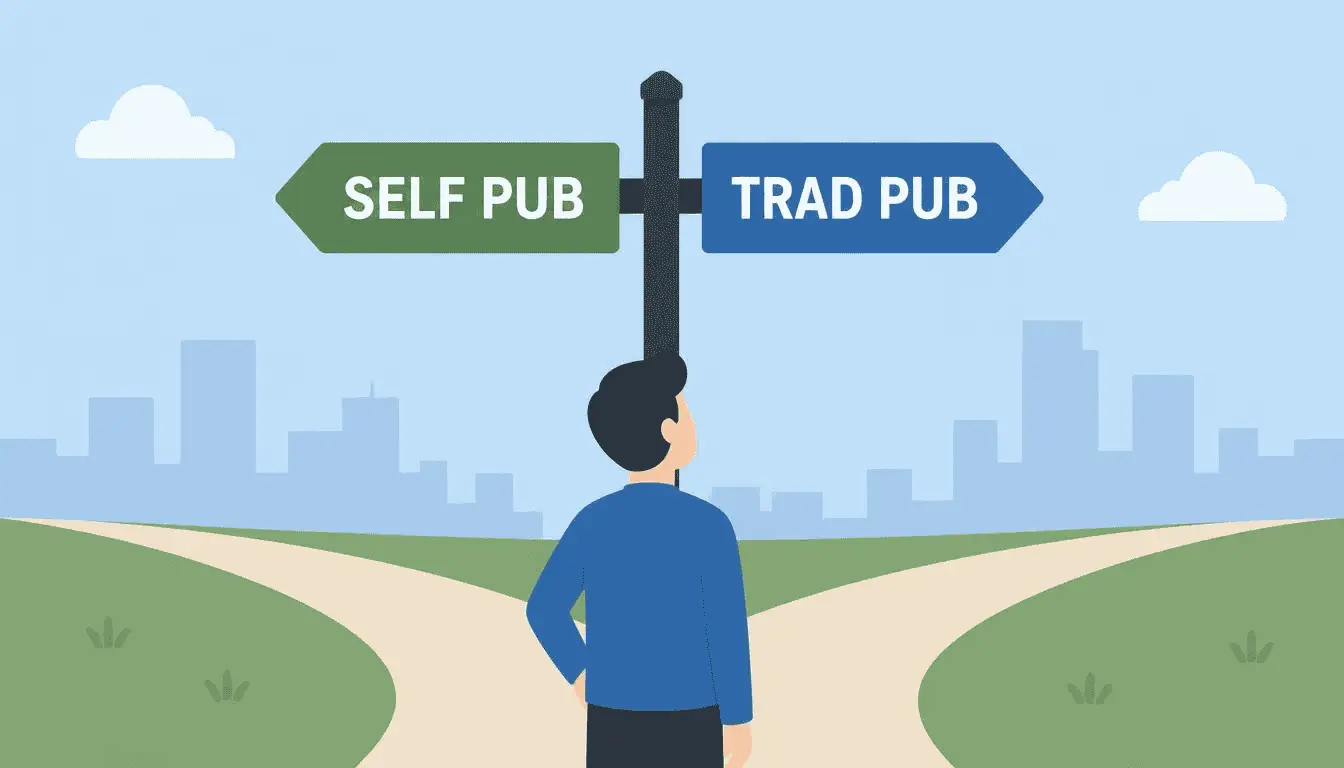
Every writer who finishes a manuscript hits the same fork in the road. One path leads to agents, editors, and bookstore shelves. The other leads to full creative control and a launch date the author picks. Neither route is easy, and neither is wrong. The right choice depends on your goals, your budget, and how much of the business side you want to handle.
This guide walks through both paths in plain language, so you can pick with confidence.
Traditional vs Self Publishing at a Glance
Here is the core split. With the traditional route, a publisher buys the rights to your book, pays for editing, design, and distribution, and gives you an advance plus royalties. With self-publishing, you pay for those services yourself and keep most of the profit and all of the control.
Editors and author coaches often describe it as a trade between support and ownership. Traditional publishing gives you a team and a prestige stamp. Self-publishing gives you speed and the final say on every decision, from the cover to the price.
The Difference Between Self Publishing and Traditional Publishing
Writers who study the difference between self publishing and traditional publishing usually focus on four areas: control, cost, speed, and reach.
Control. A traditional publisher often has the last word on your title, cover, and sometimes even your content. A self-published author decides everything.
Upfront cost. Traditional publishers pay you, never the other way around. Self-published authors cover editing, cover design, formatting, and marketing. A polished book commonly takes an investment of a few hundred to a few thousand dollars.
Speed. A traditional book often reaches shelves 18 to 24 months after the deal is signed. A self-published book can launch within weeks of the final edit.
Reach. Publishers have established relationships with bookstores, libraries, and reviewers. Self-published authors can reach readers worldwide through online retailers, but they must work harder to get into physical stores.
How to Get a Book Published: Traditional vs Self-Publishing
If you are wondering how to get a book published traditional vs self-publishing, the steps look very different.
The Traditional Route
- Finish and polish your manuscript. Fiction should be complete. Nonfiction usually needs only a proposal and sample chapters.
- Write a query letter. This short pitch introduces you and your book.
- Find a literary agent. Most major publishers accept submissions only through agents. The Association of American Literary Agents lists member agents who follow a professional code of conduct.
- Go on submission. Your agent pitches the book to editors, which can take months.
- Sign the deal. Before you do, have the contract reviewed. The Authors Guild offers contract guidance and advice on clauses that affect your rights and royalties. The publisher then takes over editing, design, printing, and distribution.
Expect rejection along the way. Many successful authors collected dozens of “no” replies before one “yes.” Patience is part of the job.
The Self-Publishing Route
- Hire an editor. Professional editing is the biggest quality marker readers notice.
- Commission a cover. Readers do judge books by their covers, especially online.
- Format your files. Use ebook and print templates, or hire a formatter.
- Choose your platforms. Many authors use Amazon KDP, IngramSpark, or both.
- Launch and market. You build your own audience, run your own promotions, and track your own sales.
How Much Do Traditional Authors Make vs Self Publishing?
Money is the question most writers ask first, so it deserves a straight answer. The honest one is that most authors on both paths earn modest amounts, and a small group earns a lot.
Here is how the numbers generally break down. Traditional contracts typically pay an advance, then royalties after the advance earns out. Royalty rates commonly sit around 10 percent of list price for hardcovers, a lower share for paperbacks, and roughly 25 percent of net receipts for ebooks. Agents usually take about 15 percent.
Self-published authors skip the advance, but they keep a far larger cut of each sale. Major retailers often pay up to 70 percent on qualifying ebooks and a significant share of print sales after printing costs. Terms change, so always check the current rates on the platform you choose.
How Much Do You Make Self-Publishing vs. Traditional Publishing per Book?
Looking at a single sale, the self-published author usually wins. A $4.99 ebook might earn the author around $3.50 when self-published, while a traditional ebook sale may return only a little more than a dollar. But the traditional author may sell far more copies through bookstore and library placement, and the advance gives guaranteed income. Self-publishing rewards authors who write quickly, publish in a series, and market consistently. Traditional publishing rewards authors whose books suit mainstream bookstores.
Self Publishing vs Traditional Publishing: Pros and Cons
Traditional publishing pros: no upfront costs, professional editing and design, bookstore distribution, and industry credibility.
Traditional publishing cons: a long wait, lower royalties, less creative control, and no guarantee that a publisher will market your book heavily.
Self-publishing pros: full control, faster release, higher royalty rates, and complete ownership of your rights.
Self-publishing cons: upfront expenses, a heavy workload, difficulty reaching physical stores, and the need to learn marketing.
Self Publishing Versus Traditional: Which Authors Thrive Where?
Patterns show up when you look at who succeeds on each path. Self-publishing versus traditional often comes down to temperament and genre.
Romance, fantasy, thrillers, and other genre fiction with hungry series readers tend to do well for self-published authors. Memoirists, literary novelists, and children’s picture book authors often benefit from a publisher’s design and bookstore reach. Business authors sometimes self-publish because the book serves as a calling card for speaking and consulting.
Authors who enjoy running a small business usually enjoy self-publishing. Authors who would rather focus on writing and let others handle production often prefer the traditional route.
Is Self Publishing or Traditional Publishing Better?
So, is self publishing or traditional publishing better? Neither wins across the board. The better choice is the one that matches your goals.
Ask yourself a few questions:
- Do I want my book in major bookstores, or is online distribution enough?
- Can I afford to invest in editing and design now?
- Am I willing to wait a year or more for publication?
- Do I want creative control more than a publisher’s backing?
- Am I excited, or intimidated, by marketing my own work?
Your answers will point you in a direction. Many authors also go hybrid, self-publishing some projects and pursuing a publisher for others. The two paths are not mutually exclusive.



Leave a Reply