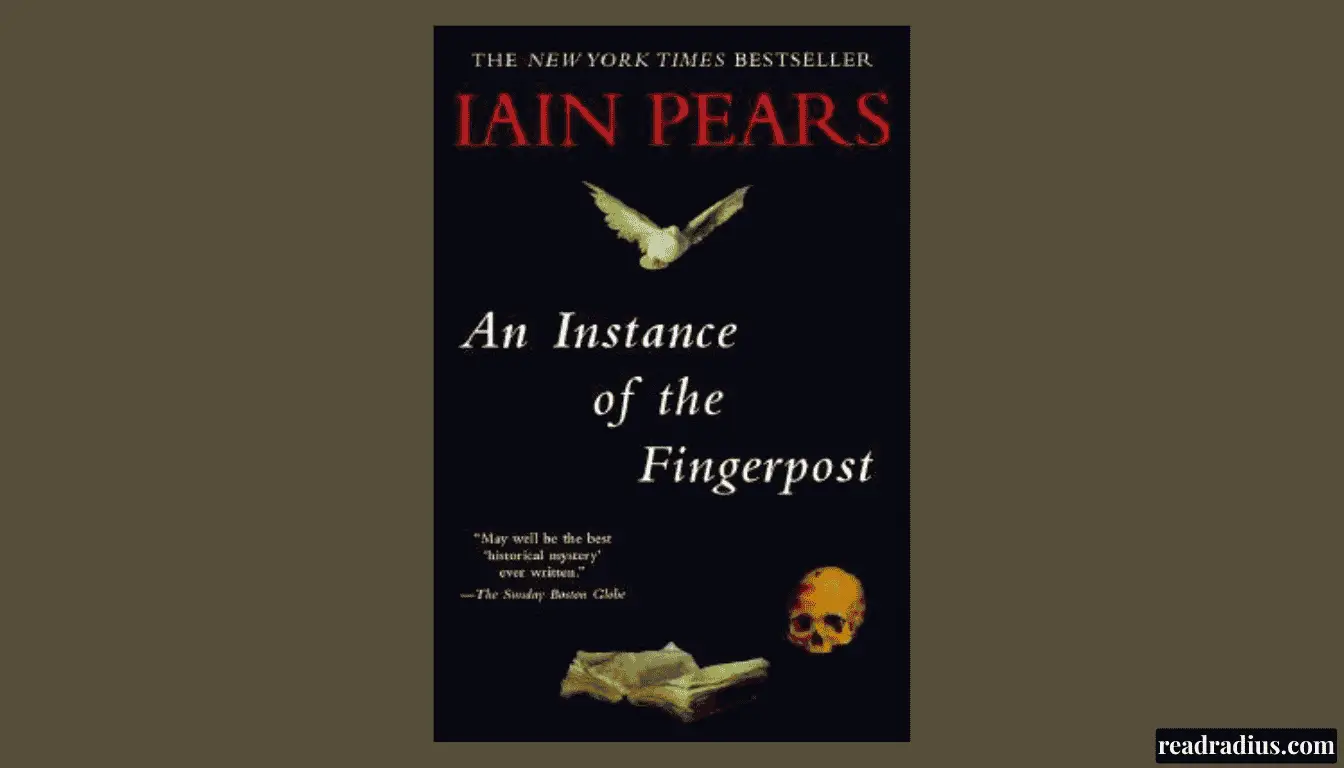
Few historical novels reward patience the way this one does. Readers who pick up An Instance of the Fingerpost expecting a straightforward murder mystery usually finish it having read four different books stitched into one, and that is precisely the point. This An Instance of the Fingerpost by Iain Pears book review looks at what makes the novel so unusual, why it still finds new readers decades after publication, and whether it deserves a spot on a historical fiction shelf next to genre classics.
The novel is set in Oxford during the 1660s, a period when England was still shaking off civil war and the scientific revolution was just getting started. A young woman named Sarah Blundy stands accused of murdering a fellow at one of the university’s colleges, and four separate narrators each tell their version of the events leading up to her trial. None of them agree. That, more than anything else, is what turns a period drama into something closer to a psychological puzzle.
What Is An Instance of the Fingerpost About? A Quick Summary
For anyone looking for an an instance of the fingerpost summary before committing to over seven hundred pages, here is the shape of it. The story unfolds in four parts, each narrated by a different character who witnessed the same string of events from a different angle. The first narrator, an Italian visitor named Marco da Cola, presents himself as a gentleman scientist with nothing to hide. The second, a bitter and unreliable Oxford scholar, sees conspiracy everywhere. The third narrator brings in the cryptographer’s eye for hidden patterns, and the fourth ties the loose threads together with a perspective that recasts everything that came before.
Each section forces the reader to reconsider what they thought they understood. A detail that seemed minor in part one turns out to be central by part four. It’s less a whodunit and more a study in how memory, bias, and self-interest shape the stories people tell about themselves.
A Personal Take on the Reading Experience
Coming to this book after years of reading tidier historical fiction, the structure took some adjusting to. The first hundred pages move slowly, and it would be dishonest to pretend otherwise. Marco da Cola’s narration is dense with period detail about medicine and philosophy, and it can feel like wading through treacle at first.
Stick with it, though, and the payoff is real. By the second narrator’s section, the earlier chapters start reading differently, and small inconsistencies that seemed like sloppy writing reveal themselves as deliberate clues. That shift, from mild frustration to genuine admiration, is something few novels manage this well. Iain Pears clearly did his homework on Restoration-era Oxford, and the historical texture never feels like research dumped onto the page for its own sake. It earns its length.
Writing Style and Structure
The four-narrator format is the novel’s biggest risk and its biggest achievement. Pears gives each voice a genuinely distinct personality rather than four versions of the same authorial tone with different names attached. Readers who enjoy unreliable narrators in the vein of Agatha Christie’s more experimental work, or the layered testimony structure found in courtroom dramas, will feel at home here.
The prose style shifts subtly with each section too. Da Cola writes with a foreigner’s curious formality, the second narrator’s paranoia bleeds into his sentence rhythm, and by the final section the pace tightens considerably as the true picture snaps into focus. It’s a demanding read, but not a difficult one once the pattern becomes clear.
An Instance of the Fingerpost Reddit Discussions Worth Reading
Book forums have kept the conversation around this novel alive for years. Searching an instance of the fingerpost reddit threads turns up a recurring theme: most readers admit the opening section tests their patience, and almost all of them say the ending changes how they feel about the entire book. Several threads compare notes on which narrator to trust, and the disagreements are half the fun. It’s rare for a novel this old to still generate active discussion, and that alone says something about its staying power.
Is There a Good An Instance of the Fingerpost Audiobook?
For readers who prefer listening over reading, an an instance of the fingerpost audiobook is available, and the format actually suits this novel rather well. Hearing each narrator’s voice performed distinctly by a narrator helps separate the four sections more clearly than some readers manage on the page. Given the book’s length, audio is a solid option for commutes or long drives, though anyone easily distracted may want to stick with print so they can flip back and check details between sections.
Best Iain Pears Books to Read Next
Anyone compiling a list of the best iain pears books tends to put this one at the top, but his other work deserves attention too. He’s written extensively in art-history mysteries as well as sweeping historical fiction, and fans of Fingerpost’s ambition often gravitate toward his longer, more structurally daring titles next.
Iain Pears Books in Order
For readers wanting to work through his catalogue methodically, knowing iain pears books in order helps make sense of how his style developed. His early works were tighter art-world mysteries, and his later fiction grew more expansive in scope and page count, culminating in the kind of layered storytelling found in Fingerpost. Reading chronologically shows a writer gradually trusting readers with more complexity.
Arcadia by Iain Pears: A Different Kind of Ambition
Where Fingerpost plays with unreliable narration, arcadia iain pears takes a different structural swing entirely, blending genres and timelines in a way that shows this author rarely repeats himself. Readers who finish Fingerpost and want more of that same willingness to experiment tend to find Arcadia a natural next stop, even though the two books share little beyond their author’s appetite for structural risk.
Final Verdict
This is not a beach read, and it doesn’t pretend to be. It asks for patience in its first act and rewards that patience generously by its last. For readers who enjoy historical fiction that respects their intelligence, unreliable narrators, and a mystery that actually holds together on a second look, this novel earns its reputation as one of the more rewarding entries in the genre.
Readers who enjoyed this deep dive into narrative structure and historical setting may also want to explore Historical Fiction Books: A Reader’s Ultimate Guide for more recommendations in the same vein.




Leave a Reply