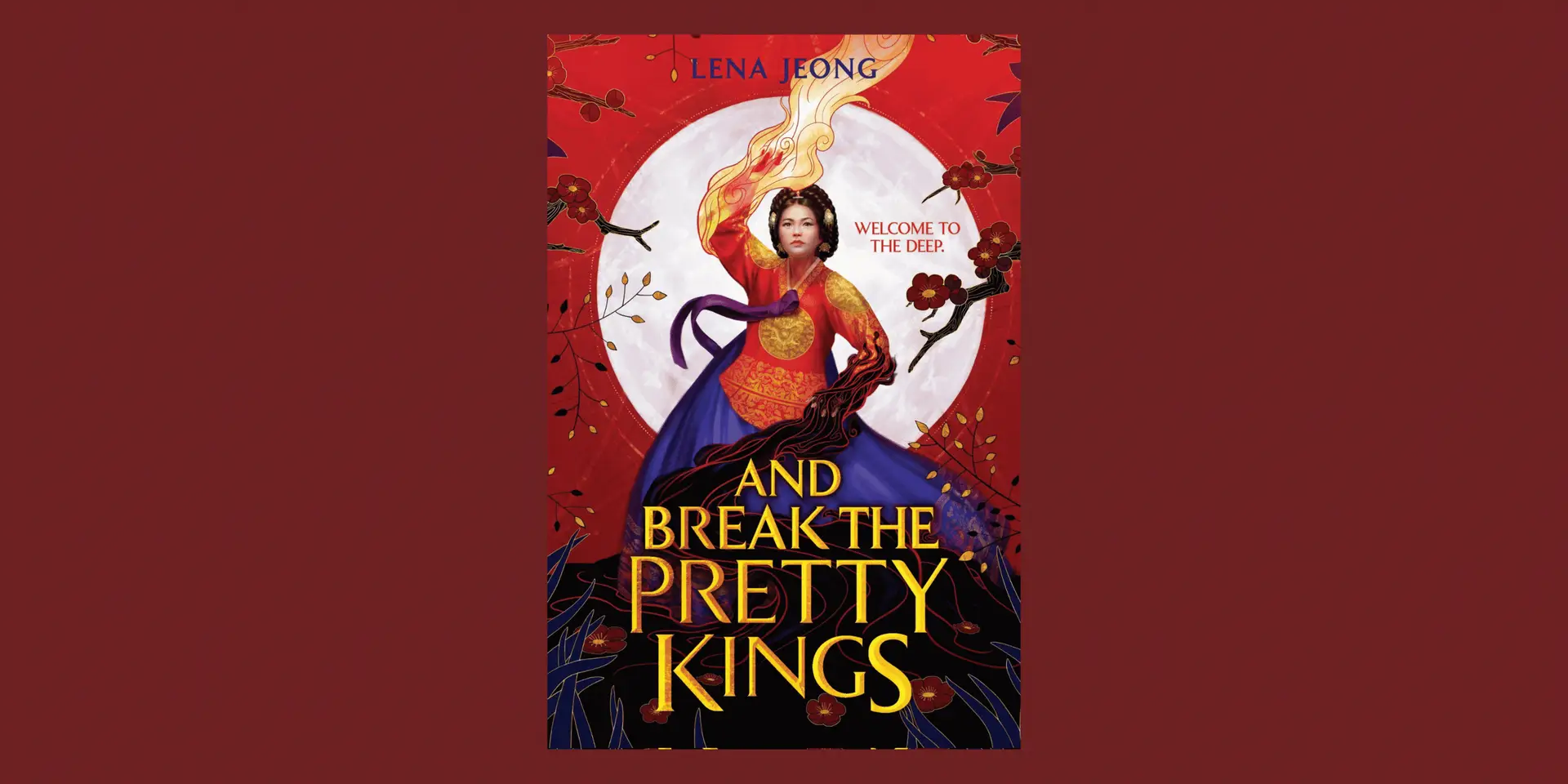
YA fantasy has spent years retelling the same Western myths. Then a wave of Asian-inspired debuts changed that and And Break the Pretty Kings by Lena Jeong is exactly the kind of book that wave was building toward. It pulls straight from Korean history and folklore, drops you inside a queendom on the verge of collapse, and hands its crown princess a magic system so intricate it takes half the book to fully understand. That ambition cuts both ways. This review breaks down what works, what stumbles, and whether the Sacred Bone series belongs on your shelf.
Book at a Glance
About the Author: Lena Jeong
Lena Jeong holds an M.F.A. in Creative Writing, and And Break the Pretty Kings is her debut novel. She is represented by literary agent Holly Root. Jeong grew up consuming YA fantasy and noticing, painfully, that none of the heroes looked like her. The all-white casts and Eurocentric settings she devoured were the only template she saw for what “good” fantasy looked like, even through her undergraduate studies and graduate program.
That changed when the #ownvoices movement began pushing publishers to take non-Western storytelling seriously. Jeong took it as a green light to write the Korean-inspired story she had always wanted to read. The result is a series that tackles predestination, divine agency, and the impossible weight placed on eldest daughters themes drawn directly from her heritage and personal experience. The Sacred Bone Series currently runs to two books, with the sequel, The Witch of Wol Sin Lake, published in 2024.
What Is And Break the Pretty Kings About? (Spoiler-Free Summary)
Sixteen-year-old Crown Princess Mirae of Seolla has spent her entire life preparing for one moment: ascending the throne and becoming the next warden of an ancient, destructive magic called the Inconstant Son. When her mother’s condition deteriorates faster than expected, Mirae must complete the Trial of the Gods ahead of schedule a trial designed to prove she can command all facets of Sacred Bone Magic and keep the Inconstant Son contained.
The trial goes catastrophically wrong. A new, unprecedented power erupts inside Mirae, death and terror consume the coronation ceremony, and the monster even the gods fear signals its return. In the chaos, her beloved older brother Minho is taken and his disappearance threatens to shatter the already fragile truce between Seolla and the neighboring sovereign state of Josan.
Mirae refuses to wait. She sets out immediately with an unlikely band of companions to find Minho, stop the ancient threat, and prevent the war looming on the horizon. Along the way, her untamed new ability gives her terrifying visions of the future timelines she must work to erase before they become real. The deeper she digs, the more she uncovers about her family’s hidden history and the true nature of the gods she has always trusted.
The ending lands like a door slamming shut on everything you thought you understood. You will want the sequel the moment you close the book.
Characters: Who Drives the Story?
Mirae
Mirae is the kind of protagonist who makes you root for her before she earns it. She is persistent, sharp, and used to carrying weight that would flatten most people. Her entire identity has been shaped by the throne there was never room for normal teenage mistakes or friendships, only preparation. That pressure makes her compelling, even when her decisions frustrate you. She does not always make the right call, and the book is better for it. Her arc pushes her to question everything she was taught, dismantle inherited beliefs, and decide what kind of queen and person she actually wants to be.
Hongbin and the brother dynamic
The emotional engine of this book is not a romance. It is the bond between siblings. Hongbin, Mirae’s brother, is an immediately lovable character warm, genuine, and easy to care about. His kidnapping hits hard precisely because Jeong takes the time to make you love him before she takes him away. Mirae’s relentless drive to find him feels earned at every step because you feel that love too.
The companion group and antagonists
The companions Mirae picks up on her journey serve their plot functions well. Some readers find their characterization thin a fair critique for a debut. They lack the depth Mirae and Hongbin get, which means the emotional stakes of the quest rest almost entirely on the sibling relationship. The villain situation is more divisive. Jeong deliberately keeps antagonist identities ambiguous, which some readers experience as suspense and others experience as whiplash. The backstories, once revealed, do add genuine texture to the antagonists, but the path to those revelations is rockier than it needs to be.
The Magic System in And Break the Pretty Kings: A Review of All Three Systems
The magic is one of the most distinctive things about this book. Seolla operates on three separate systems, each with its own rules, feel, and cultural grounding. Mirae has to master all three, which means readers learn them alongside her a smart structural choice that keeps the exposition from feeling like a lecture.
Seolla’s Three Magic Systems
On top of these three systems sits Sacred Bone Magic itself a divine lineage power unique to Seolla’s ruling bloodline. Mirae’s emerging abilities exceed all three known systems, which is where the real tension lives. The magic is genuinely inventive, and Jeong draws each system from Korean mythological traditions rather than generic Western fantasy archetypes. The time-vision mechanic in particular is clever it raises stakes by showing Mirae exactly what she is racing to prevent. Some reviewers feel it is underused relative to how much potential it has, and that is a fair point. The concept earns more page time in the sequel.
Fans of time-based storytelling will also want to explore our Best YA Time Travel Books You Need to Read.
World-Building: Korean History and Mythology Done Seriously
The setting is the strongest element in And Break the Pretty Kings, and it is not particularly close. Seolla draws directly from the historical Three Kingdoms period of Korea a complex era of rival dynasties, shifting alliances, and intense court politics. The rival state of Josan provides immediate geopolitical pressure: war is always one wrong move away, which gives Mirae’s quest a ticking-clock urgency that the pacing sometimes fails to match.
The Korean mythological layer runs deep. The gods in this world are not benevolent protectors. They have agendas. They interfere, they withhold, and they punish. Jeong uses this divine unreliability as a direct thematic tool trusting authority figures, even divine ones, is something Mirae has to learn to interrogate. There is also a dragon, which delights essentially every reader who encounters it.
The worldbuilding has the feel of an author who wrote thousands of words of history that never made it into the final book and that density shows on the page in the best way. Details accumulate into something that feels genuinely lived-in rather than constructed for plot convenience.
Themes That Go Deeper Than the Plot
Major Themes
-
Destiny vs. agencyIs the future fixed, or do we choose it? Mirae’s time visions force this question from abstract to immediate. Every choice she makes carries the weight of prophecy she cannot fully trust.
-
The burden of eldest daughtersMirae was raised to lead, to protect, and to sacrifice. Normal teenage experience friendship, mischief, romance was never on the table. The book treats this loss with real empathy rather than as backstory flavor.
-
Familial love as the true driving forceThis is a book about siblings, not romance. Mirae chooses her brothers repeatedly, at great cost and the story is emotionally richer for centering that kind of love instead.
-
Questioning inherited truthAuthority figures parents, queens, gods pass down belief systems that serve their interests. Mirae’s real education is learning to dismantle those frameworks and decide what she actually believes.
-
Cultural visibility in fantasyJeong wrote this book to fill the gap she felt as a teen reader. The Korean-inspired world is not decoration it is the entire point. The book functions as an act of cultural reclamation within a historically Eurocentric genre.
These themes do not float above the story they are embedded in the plot mechanics. The prophecy system is the destiny theme made tangible. Mirae’s resistance to the gods is the questioning-authority theme in action. This is one of the areas where Jeong’s M.F.A. background shows most clearly: the thematic architecture is intentional and structurally sound even when the pacing stumbles.
Honest Pros and Cons of And Break the Pretty Kings
What Works — What Doesn’t
- ✓ Rich Korean mythological world-building the genuine standout
- ✓ Three-system magic structure is inventive and well-differentiated
- ✓ Family over romance as the emotional core refreshing in YA
- ✓ Lyrical, accessible prose that moves quickly once it finds its footing
- ✓ Time-vision mechanic raises genuine narrative stakes
- ✓ Villain backstories add moral complexity when they land
- ✓ Dragon. No further justification required.
- ✓ Ending strong enough to demand the sequel immediately
- ✗ Pacing drags despite a firm narrative deadline
- ✗ World information arrives unevenly early chapters leave gaps
- ✗ Villain identity flip-flops without enough build-up between shifts
- ✗ Romance is teased but never develops frustrating given how often it surfaces
- ✗ Supporting companions lack distinct characterization
- ✗ Some problems resolve too conveniently for the stakes to feel real
- ✗ Horomancy feels underused relative to its potential
Most of the weaknesses trace back to a single root cause: this is a debut novel carrying an enormous amount of ambition. Jeong builds a world with the complexity of a three-book series while also trying to run a high-stakes rescue quest and introduce a cast of characters and set up a romance and establish a magic system all in under 450 pages. Some things get crowded out. The sequel, The Witch of Wol Sin Lake, carries a noticeably higher Goodreads rating (3.56 versus 3.17), which suggests Jeong absorbed the feedback and grew into the space she built here.
If You Liked These Books, Read And Break the Pretty Kings
Read-Alikes
What separates And Break the Pretty Kings from most of its read-alikes is specificity. The Korean roots here are not pan-Asian window dressing they are Three Kingdoms-era political history, specific mythological creatures, and a magic system built from Korean folk tradition. Readers who want something genuinely rooted in a culture, rather than generically “East Asian fantasy,” will find it here.
Final Verdict: Should You Read And Break the Pretty Kings?
Our Verdict
Skip it if: slow-build pacing kills your momentum, or you need a romance payoff within the same book.
The Sacred Bone series is the kind of thing the genre needs more of not a retelling of Western myth with an Asian aesthetic applied on top, but a story built from the inside out on Korean history, Korean mythology, and a Korean-American author’s genuine cultural stake in the material. Lena Jeong stumbles in places a more seasoned novelist would not. She also does things in this debut that more seasoned novelists cannot, because the specificity and authenticity of this world belongs entirely to her.
Pick it up. Then pick up The Witch of Wol Sin Lake. The series earns your patience.




Leave a Reply