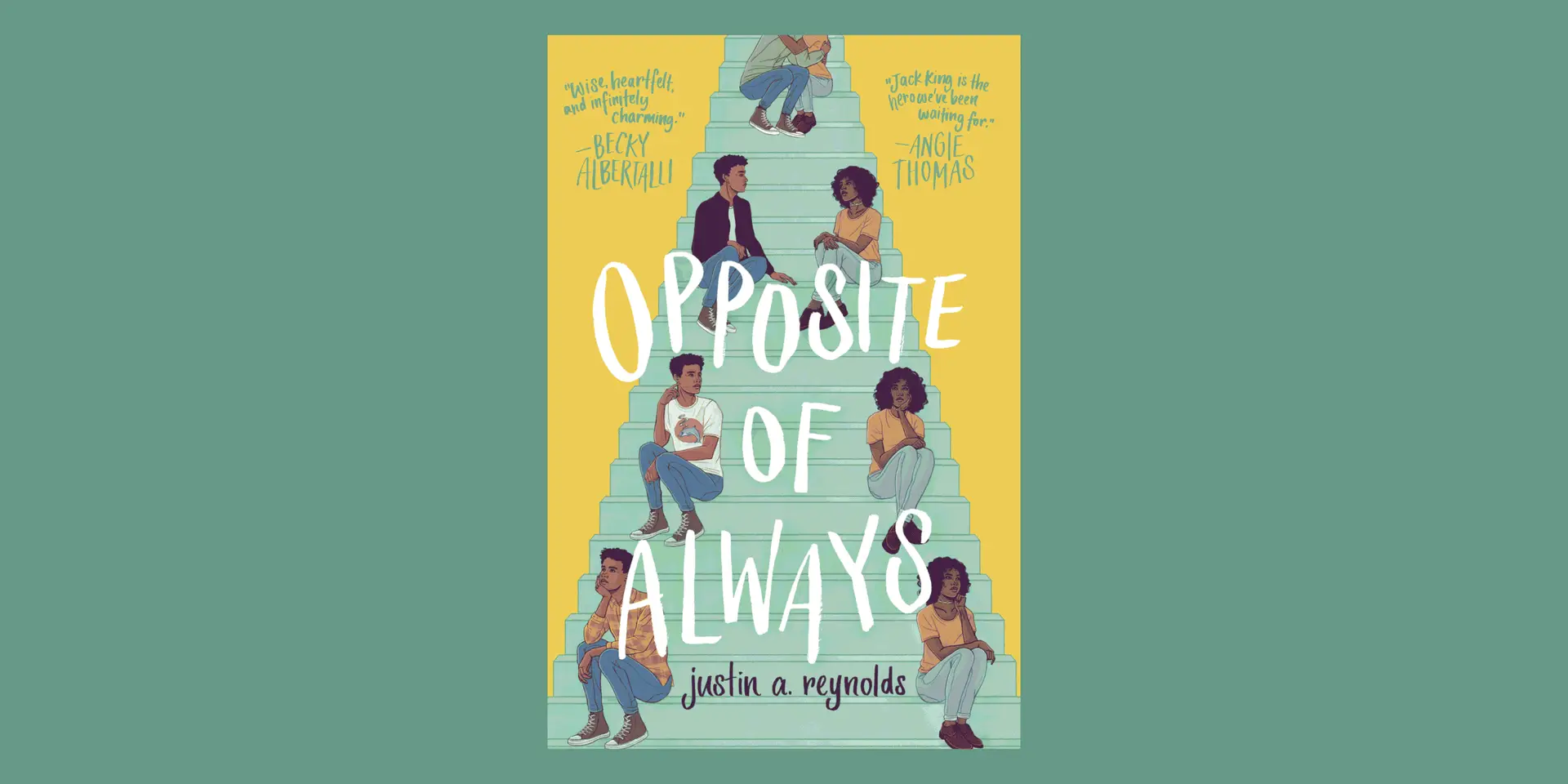
Some books make you laugh. Some make you cry. A rare few do both so relentlessly that you finish them feeling emotionally wrung out in the best possible way. Opposite of Always by Justin A. Reynolds is that rare book.
Published in March 2019 by Katherine Tegen Books, this debut YA novel dropped quietly then exploded. It earned a spot on the School Library Journal Best Books of 2019 list, landed an Indies Introduce Top Ten selection, and quickly got optioned for film by Paramount Players. It has since been translated into 19 languages and even adapted into a Webtoon. For a debut, that trajectory is extraordinary.
But numbers do not tell you whether a book is actually worth your weekend. So let me do that instead.
Book at a Glance
Opposite of Always Review: What the Book Is Actually About
Jack Ellison King is the self-described “King of Almost.” He almost made valedictorian. Almost made varsity. Almost told his best friend Jillian how he felt about her before she started dating his other best friend, Franny. Jack is the kind of lovable mess you root for immediately because, honestly, you have met him before. Maybe you have been him.
At a college party, Jack sits on a staircase next to a girl named Kate. They talk until sunrise about Froot Loops and old movies. He falls hard, fast, and completely. What follows is a sweet and giddy first love until Kate collapses and dies from complications of sickle cell anemia.
Then Jack wakes up back at the party. On the same staircase. Next to Kate again.
He is stuck in a time loop that spans exactly six months from the night he meets Kate to the night he loses her. Each loop, he tries a different strategy to save her. Each loop, something else breaks. He keeps the life of the girl he loves, but risks losing Franny to legal trouble, or destroying his parents’ trust, or watching Jillian drift away. Reynolds uses the loop structure to ask a genuinely hard question: What are you willing to sacrifice to save one person? And the answer Jack keeps discovering is that you cannot save everyone.
Reader Voices
“One of the best love stories I’ve ever read.” — Angie Thomas, #1 New York Times bestselling author of The Hate U Give
The Writing Style Feels Like a Best Friend Talking to You
Reynolds writes the way a naturally funny person talks quick, warm, and slightly self-deprecating. Jack narrates in first person, directly to the reader, and that intimacy makes the book work on a level that pure plot cannot explain. His chapter titles alone are worth the price of admission. They function like jokes set up one chapter and paid off in the next, and they keep the pacing sharp even when the loop mechanics risk growing repetitive.
The comparison to John Green is fair, but it undersells Reynolds. Where some of Green’s earlier protagonists could slip into manic pixie dream territory, Jack and Kate feel like full people. Kate pushes back on Jack. She has her own opinions, her own humor, her own reasons for guarding herself. The romance earns its emotional payoff because Reynolds takes both characters seriously.
The dialogue crackles. There is a scene involving a box of cereal, a hospital cafeteria, and absolutely terrible dancing that is funnier on the fourth read than the first. Reynolds has a gift for comedy that sits right next to heartbreak without undercutting either which is an incredibly difficult balance to strike, and he makes it look effortless.
What Sets This Book Apart from Other YA Time-Loop Novels
Time-loop stories live or die by what the protagonist does with the repeated time. Reynolds makes a smart structural choice: each loop is not a carbon copy. Jack has different information, makes different bets, and faces genuinely different consequences. The same events shift in meaning depending on what Jack chooses to prioritize. This stops the book from feeling like a series of near-identical chapters, which is the trap most time-loop stories fall into. If you are a fan of these high-stakes stories, you should check out our list of the Best YA Time Travel Books You Need to Read.
The diversity in the cast is also handled with a naturalness that still feels rare in YA. Jack, Jillian, and Kate are Black. Franny is Latinx. Their backgrounds are part of who they are informing their family dynamics and friendships without the book ever reducing them to a lesson. Reynolds is one of them. He writes from the inside, and you feel it.
The sickle cell anemia storyline deserves a specific mention. Reynolds was inspired to write this book after losing two important people in his life a close friend and his aunt. That grief lives in the pages. He portrays the condition with accuracy and dignity, and it is one of the very few YA novels that puts this disease at the center of a story. Readers who have the condition, or who know someone who does, will find themselves seen in a way that most books never offer them.
Where the Book Does Not Fully Deliver
No review worth reading pretends a book is perfect. Opposite of Always has two genuine weaknesses.
First, the time-travel mechanics are left deliberately unexplained. Reynolds never tells you why Jack loops, what triggers it, or how it will end. Some readers find this liberating it keeps the focus on the emotional story rather than the fantasy logistics. Others find it frustrating, especially near the ending when you want some sense of internal logic to tie things together. If you need your supernatural premises to follow clear rules, the ambiguity will bother you.
Second, the repetition does accumulate. The opening party scene is a fixed anchor point that Jack returns to multiple times, and while Reynolds changes what happens after it, the repeated setup can feel sluggish in the middle section of the book. Readers who bounce off time-loop structures in general will feel this more sharply than those who embrace the format.
These are real criticisms. They are also the kinds of criticisms you only notice because the rest of the book sets the bar high enough that you want it to be perfect.
The Movie Question: Will It Work on Screen?
Paramount Players optioned Opposite of Always for film development and frankly, it is not hard to see why. The story is visual, the dialogue is punchy, and the structure (multiple timelines converging on a single emotional payoff) is a screenwriter’s natural playground. The book was also adapted into a Webtoon, which brought the story to a completely different audience.
Whether the adaptation ever makes it to a cinema screen, the book already feels cinematic. There are scenes a rooftop, a grocery store cereal aisle, a hospital hallway at 2 a.m. that you picture in frames while you are reading them. Reynolds writes visually without even trying to.
Final Thoughts on the Opposite of Always Book Review
Justin A. Reynolds wrote this book out of grief and you feel that truth on every page. He was not just crafting a clever plot device. He was asking what it would mean to get more time with someone you loved and lost. The time loop is the vehicle. The real story is about whether love, loyalty, and a teenager with a lot of heart can outrun the worst things life throws at a person.
The answer the book gives is not simple, and it is better for that. Jack does not magically fix everything. He learns painfully, repeatedly that choosing one person sometimes costs another. That doing everything you can still might not be enough. And that the people who love you are worth fighting for even when the fight looks impossible.
Pick it up. Read it in a weekend. Then hand it to whoever in your life always comes in second and tell them this one is for them.
For another perspective on Jack and Kate’s journey, you can also read the review over at Amy’s Bookshelf.
4.5
out of 5
Our verdict: Opposite of AlwaysA debut that reads like a fifth novel. Reynolds writes with the kind of confidence and emotional intelligence that most authors spend a decade developing. The humor is real, the heartbreak is earned, and the friendship dynamics are the best you will find in YA this decade. A few loose ends in the time-travel logic and mid-book pacing dips keep it from a perfect score but not from your shelf.


Leave a Reply