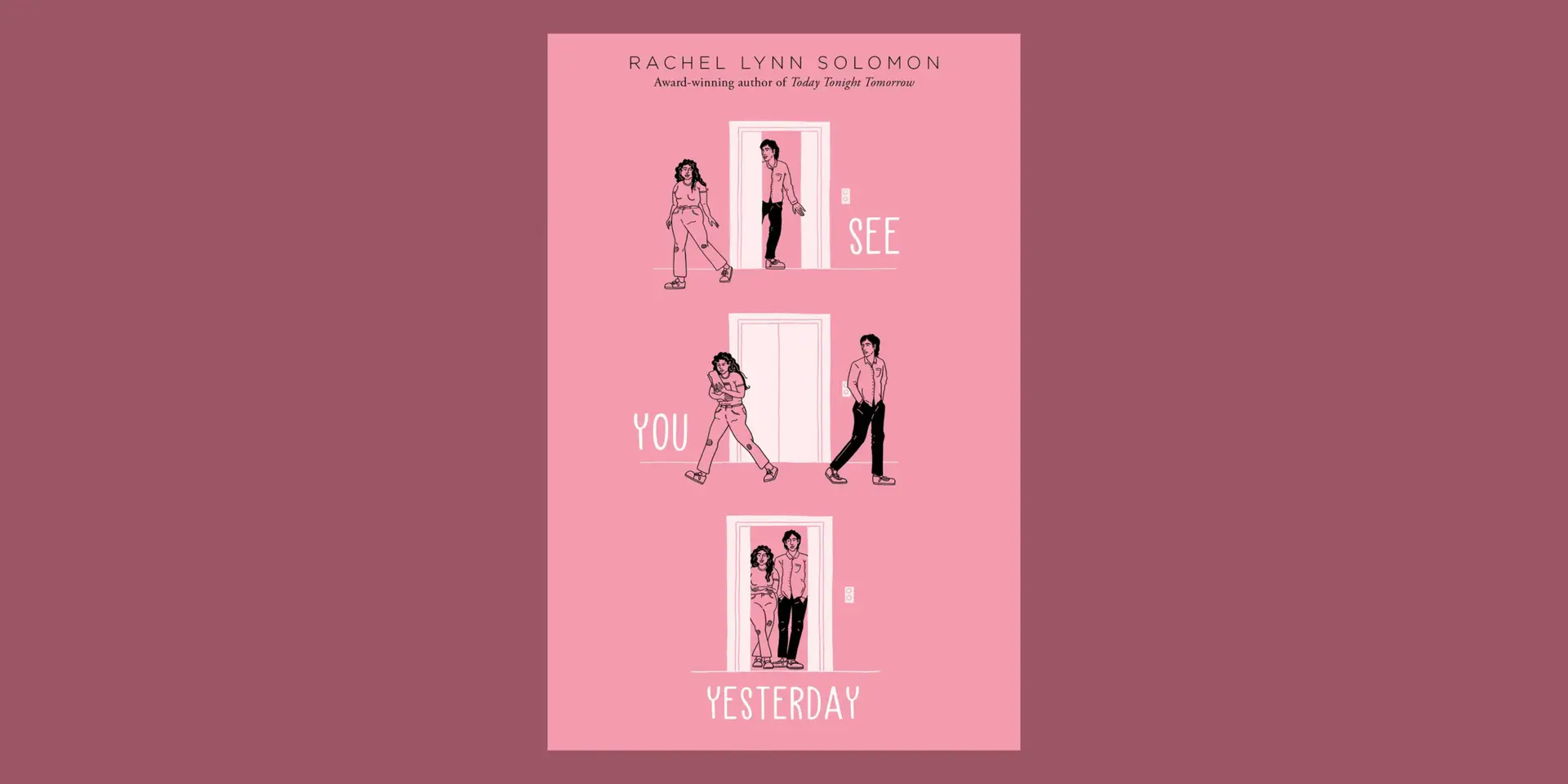
There is a specific kind of reading experience where you pick up a book at ten at night, tell yourself you will read two chapters, and then surface at two in the morning having finished the whole thing. See You Yesterday by Rachel Lynn Solomon is exactly that kind of book. It is funny, it is tender, it is smarter than it looks on the surface, and it left me thinking about it for days after I closed the last page.
I picked this one up because I had already loved Today Tonight Tomorrow, and I wanted to see what Solomon would do with a time-loop premise. What I did not expect was how emotionally rich the whole thing would turn out to be. This is not just a cute Groundhog Day romance. It is a book about identity, shame, healing, and what it means to let someone in wrapped inside a genuinely clever speculative concept that earns every moment of its logic.
Book at a Glance
What See You Yesterday by Rachel Lynn Solomon Is Actually About
Barrett Bloom arrives at the University of Washington on September 21st with one mission: reinvent herself. High school was a disaster she would rather forget. She exposed corruption on the school tennis team through the student newspaper, lost her best friend because of it, got bullied relentlessly, and ended prom in the most humiliating way possible. College feels like a second chance a clean slate.
It does not go that way. On her very first day, she wakes up to find her new roommate is Lucie, a girl from high school she has a painful history with. She bombs her interview for the college paper. A smug physics student named Miles Kasher-Okamoto embarrasses her in front of the whole class. And then, to top it all off, she accidentally knocks over a tiki torch at a frat party and sets the place on fire. She ends up sleeping in the dormitory common room because she is locked out of her own room.
And then she wakes up. And it is September 21st. Again.
When Barrett corners Miles in physics class on her third loop, she discovers he has been stuck in the time loop for months. He has been living the same disastrous day at the University of Washington long before she arrived. Together, they decide to work on breaking the cycle through scientific research (Miles), through personal growth (Barrett’s theory), and through the kind of forced proximity that inevitably produces feelings neither of them was expecting.
See You Yesterday Review: Characters, Chemistry, and What Solomon Does Differently
Barrett Bloom is the protagonist you will root for from page one
Barrett is not a passive character. She is sharp, self-aware, funny, and genuinely wounded in ways that feel real rather than performed. Her backstory involves journalism, betrayal, and a prom experience that left a mark she cannot just shake off by showing up to a new school. Solomon does not treat that trauma as a single explaining moment and move on. Barrett carries it through every interaction, every instinct, every time she hesitates to trust someone new and watching her slowly unlearn some of those protective habits is one of the most satisfying arcs in the book.
I have read a lot of YA where the female protagonist describes herself as awkward and the narrative never really backs that up. Barrett actually earns it. Her missteps feel genuine, her insecurities are specific, and her humor is the kind that comes from someone who has learned to use wit as a shield. She felt like a real person to me, not a type.
Miles Kasher-Okamoto might be one of the best love interests in recent YA
Miles is a physics prodigy who, after months trapped in the loop, has become a strange blend of exhausted and methodical. He is half Japanese American, half white, and Jewish and Solomon handles his identity with the same care she brings to Barrett’s. He is not defined by any single characteristic. He is awkward in specific ways, warm in ways he does not fully realize, and carrying his own complicated backstory involving his family and a kind of loneliness that mirrors Barrett’s even though it arrived through completely different circumstances.
The enemies-to-lovers trajectory here is slow and it earns every step. Their banter is sharp. Their first moments of genuine vulnerability feel surprising because Solomon has been building to them so carefully. I will not say anything more specific because spoilers, but the scene where the dynamic between them genuinely shifts you will know it when you get there, and it is worth every page of buildup.
The time loop mechanics actually make sense
One thing that frustrates me about some time-loop stories is that the mechanics are vague enough to feel like a cheat. Solomon does something smarter here. Miles approaches the loop as a physics problem he has been documenting it, forming hypotheses, running experiments. Barrett suspects the answer might be less scientific and more emotional. The tension between those two frameworks drives a lot of the plot’s middle section, and the resolution pulls both threads together in a way that feels genuinely satisfying rather than convenient.
The repetition of September 21st never gets boring on the page because each loop reveals something new. A different conversation with Lucie. A different choice at the frat party. A new corner of Miles that Barrett has not seen before. If you are worried the structure will feel monotonous it does not. Solomon paces the reveals expertly.
The deeper themes are what elevate this above a standard rom com
Underneath the romance and the time-travel cleverness, See You Yesterday is a book about reinvention and the limits of it. Barrett wants college to change her, but Solomon is asking a harder question: can you actually outrun who you are? Or do you have to face it? The loop becomes a metaphor for that you cannot just skip past your worst day. You have to live it until you understand it.
The book also handles some genuinely heavy material past sexual harassment, bullying, family drug addiction, and the kind of grief that comes with losing a friendship to circumstances outside your control. None of it is treated as backstory filler. All of it connects to character behavior in ways that feel considered and honest. Solomon is a writer who clearly respects her readers enough to go to difficult places without softening them into nothing.
The Jewish identity of both leads is also woven naturally into the story. It is present in small, specific ways not as a plot point but as part of who these people are. That kind of representation, quiet and specific and not performing for anyone, is exactly what good rep looks like.
If you enjoy stories that use genre elements to explore bigger emotional truths, check out our roundup of the Best YA Time Travel Books You Need to Read several of them take a similar approach to what Solomon does here.
What Works and What Might Not Work for Everyone
Nothing is perfect, and I want to be honest with you rather than just write fan copy. Here is where the book earns high marks and where a small handful of readers might find friction.
What absolutely works: The chemistry between Barrett and Miles is the real engine of this book and it runs the whole time. The writing is genuinely funny not in that self-conscious YA quirky way, but in the way of someone who understands timing. The emotional depth sneaks up on you. The ending is satisfying in both the romantic and the thematic sense, which is harder to pull off than it sounds.
Where some readers might hesitate: The book is shelved as YA but it reads more like new adult it deals with sex in a frank and age-appropriate way, and the emotional subject matter skews toward late teens and early twenties. If you are picking this up for a younger teen, be aware of that. A small number of reviewers also noted that Miles occasionally plays into the “nerdy Asian guy” archetype, though most felt Solomon handled his character with enough specificity to avoid it becoming a flat stereotype. It is worth knowing about going in.
The middle section, where Barrett and Miles are in a rhythm of trying different approaches to break the loop, can feel slightly stretched if you are reading quickly. I personally did not mind it I liked spending time in their dynamic but if you tend to push hard for plot momentum, be patient. The payoff is worth it.
A Few Words on Rachel Lynn Solomon as a Writer
If you have not read anything by Solomon before, this is a genuinely excellent place to start though Today Tonight Tomorrow is the other obvious entry point if you want to understand what she does at her best. What she is good at is writing romantic tension that does not rely on misunderstanding or manufactured conflict. Barrett and Miles are not kept apart by some contrived plot obstacle. They resist each other because of who they are and what they are afraid of, and that makes the resolution feel earned in a way that a lot of romances simply do not achieve.
She is also unusually good at supporting characters. Lucie, who could easily be a flat villain, gets enough small moments within the loop that she becomes someone Barrett and the reader can hold a more complicated feeling about. The physics professor, Barrett’s mother, Miles’s family situation: all of it is rendered with a specificity that makes the world feel inhabited rather than staged.
According to Kirkus Reviews, which gave it a starred review, Solomon presents a sex-positive love story featuring Jewish teens dealing with loneliness, stress, and secrets and that framing is accurate. She handles intimacy between her characters with an honesty that still feels rare in YA, treating teenagers as people who have real feelings and real bodies without either sensationalizing or sanitizing that reality.
Final Thoughts Should You Read See You Yesterday?
Yes. Without hesitation.
I came into this book expecting a fun, frothy romance with a clever gimmick. What I got was all of that, plus a story that genuinely moved me and left me thinking about its core question whether reinvention is something that happens to you or something you do long after I finished. That kind of surprise is what separates a good read from a memorable one.
If you are a fan of contemporary romance with a speculative edge, this is one of the best examples the genre has produced in recent years. It earned its starred reviews from Kirkus, School Library Journal, and Publishers Weekly and it earned them honestly. Solomon wrote something that knows exactly what it is and executes it with genuine skill.
Pick it up. Read it in one sitting if you can. You will not regret it.


Leave a Reply