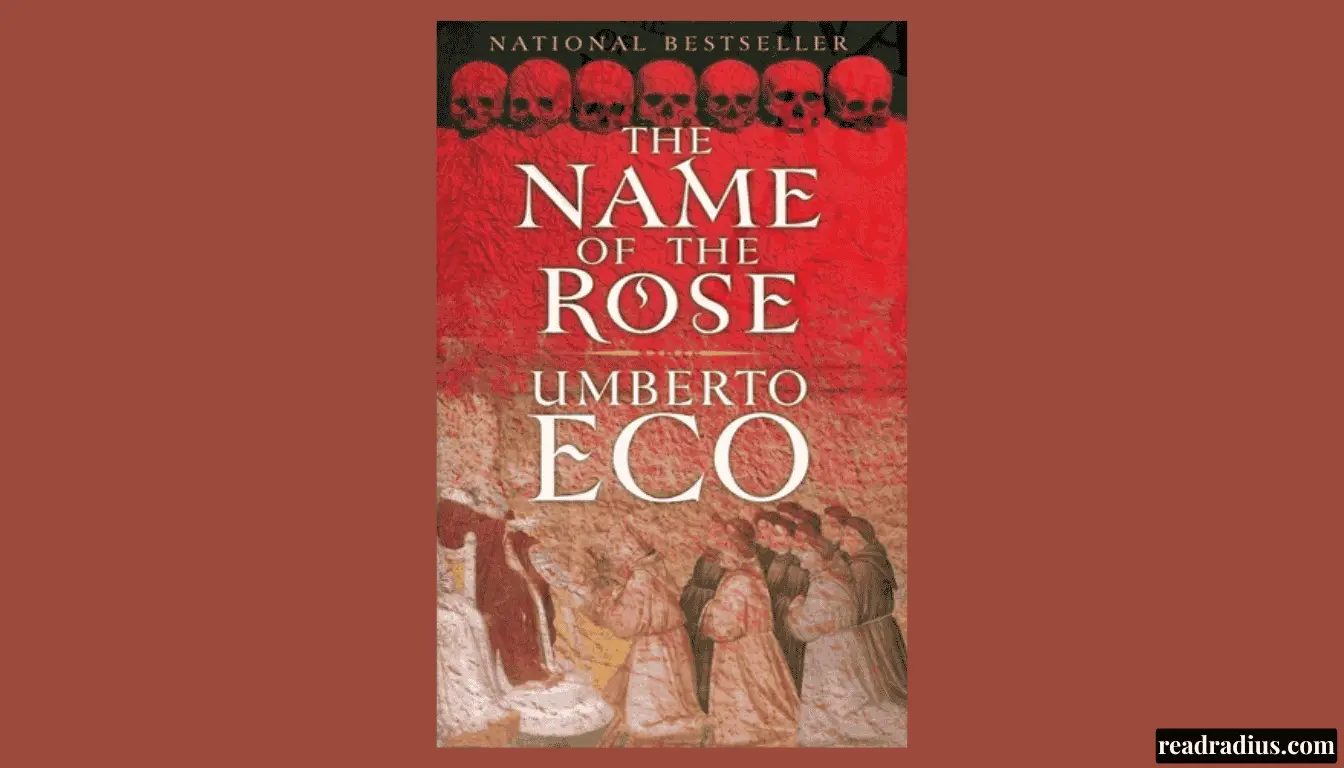
Some novels are read once and forgotten. Others sit on a shelf for years, get picked up again, and reveal something new each time. The Name of the Rose by Umberto Eco belongs firmly in the second category. It is a book that rewards patience, curiosity, and a willingness to sit with difficult ideas and that combination is exactly why it still gets discussed in book clubs, university seminars, and late-night reading sessions decades after it was first published.
This review takes a close look at the novel, its structure, and the reasons it continues to be one of the most talked-about works of literary fiction to come out of Italy.
The Name of the Rose by Umberto Eco Summary
At its core, the name of the rose by umberto eco summary can be boiled down to a murder mystery set inside a fourteenth-century Benedictine monastery. Brother William of Baskerville, a Franciscan friar known for his sharp logic, arrives at the abbey alongside his young apprentice, Adso of Melk, to attend a theological debate. Instead, he finds himself pulled into investigating a string of deaths among the monks.
As William digs deeper, the trail leads him toward the abbey’s labyrinthine library, a place guarded with almost obsessive secrecy. What begins as a straightforward whodunit slowly turns into something much larger: a meditation on knowledge, censorship, faith, and the lengths people will go to protect or destroy forbidden ideas. Readers who enjoy a slow burn rather than a fast-paced thriller tend to find this structure deeply satisfying, since every clue ties back to questions about truth and power.
Rose by Umberto Eco: Why the Setting Matters So Much
Calling this simply a rose by umberto eco mystery undersells how much the setting does for the story. The monastery itself functions almost like a character. Its cold stone corridors, hidden passageways, and the imposing library tower create a constant sense of claustrophobia and tension. Eco, who was a medieval scholar before he became a novelist, brings an authenticity to the period that few writers manage. Readers genuinely feel transported to a world governed by Latin liturgy, religious politics, and the looming threat of the Inquisition.
From personal experience reading this novel during a particularly slow winter, the atmosphere is what lingers longest. It’s not just a backdrop it actively shapes how the mystery unfolds and why certain characters behave the way they do.
The Name of the Rose as a Postmodern Novel
Literary critics frequently discuss the name of the rose as a postmodern novel, and once readers notice the layers Eco builds into the text, it’s easy to understand why. The novel constantly plays with the idea of narrative reliability. It is framed as a manuscript discovered and translated by Eco himself, which immediately blurs the line between fiction and historical record. This technique, sometimes called metafiction, invites readers to question who is really telling the story and how much of it can be trusted.
Eco also weaves in dense intertextual references, pulling from theology, semiotics, and philosophy, which gives the book a layered quality rarely found in conventional mystery fiction. For readers interested in literary theory, this is part of what makes the novel feel ahead of its time, even though it was first published in 1980.
The Name of the Rose Critical Analysis
A proper the name of the rose critical analysis has to address the tension between two genres the book straddles: the detective story and the philosophical novel. William of Baskerville’s investigative method, heavily inspired by Sherlock Holmes, gives the book its narrative momentum. But Eco never lets the mystery stay simple. Every clue uncovered raises bigger questions about how institutions control access to knowledge, and how fear of new ideas can turn deadly.
Critics often point to the library itself as the novel’s central symbol. It represents both the preservation and the suppression of knowledge, a theme that feels just as relevant in today’s conversations about misinformation and censorship as it did in 1327, when the story is set. This is part of why academic interest in the book has never really faded, and why students still search for the name of the rose analysis pdf resources when preparing essays or thesis papers.
Umberto Eco Books: The Name of the Rose’s Place Among Them
Among all the umberto eco books, the name of the rose remains the most widely read and most frequently adapted, including a well-known 1986 film starring Sean Connery. While Eco went on to write other acclaimed novels like Foucault’s Pendulum and Baudolino, none quite matched the cultural reach of this debut work of fiction. Part of that staying power comes from how the novel balances accessibility with intellectual depth readers don’t need a background in semiotics to enjoy the mystery, but those who do bring that knowledge will find even more to appreciate.
Final Thoughts
The Name of the Rose isn’t a light read, and it doesn’t try to be. It asks for attention, patience, and a willingness to sit with long passages of theological debate before the next clue drops. For readers who enjoy historical fiction with real intellectual weight behind it, this novel remains one of the genre’s high points. It’s the kind of book worth keeping on a shelf, not just for a single read, but for the re-reads that reveal something new each time.
Want more Book to read About: Historical Fiction Books: A Reader’s Ultimate Guide




Leave a Reply