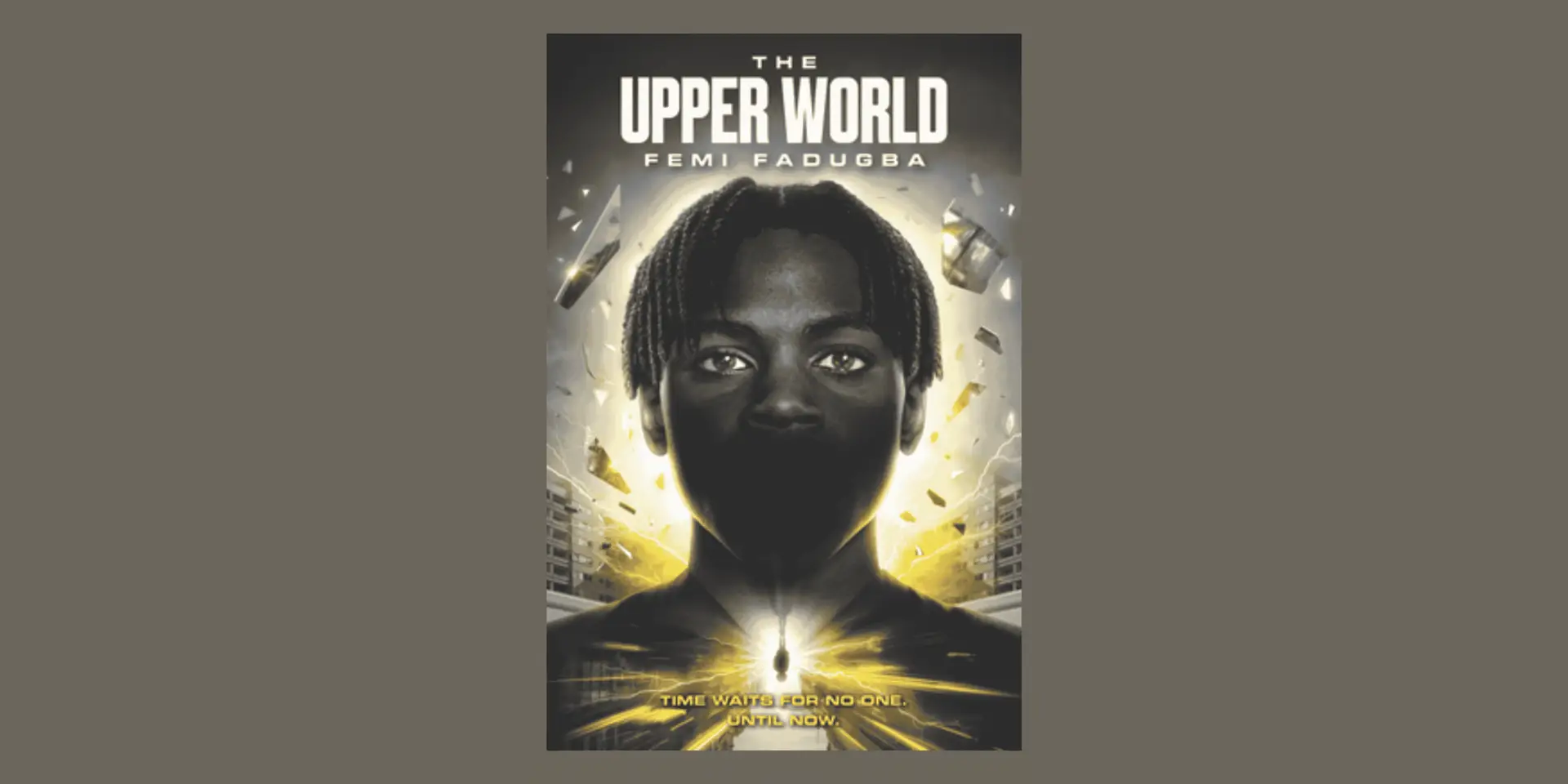
There are books you read and books you experience. The Upper World sits firmly in the second category and not just because a physicist wrote it.
I picked this one up knowing almost nothing about it, other than that it was set in South London and involved time travel. Two chapters in, I had already dog-eared three pages. By the midpoint, I had abandoned my lunch to keep reading. That alone tells you something.
This review of The Upper World by Femi Fadugba covers everything you need to know: the plot, the characters, the themes, what works brilliantly, what slightly creaks, and who should absolutely get their hands on a copy.
Book at a Glance
The Upper World by Femi Fadugba Review: What Makes This Book Stand Apart
Debut novels are a gamble. Writers tend to either overstuff their first book with every idea they have ever had, or they play it safe and deliver something forgettable. Fadugba does neither. He arrives fully formed confident voice, controlled structure, and a premise that genuinely has not been done before.
The hook is deceptively simple. Sixteen-year-old Esso Adenon is a South London teenager who is, in his own words, trying to avoid getting sucked into the gang war dragging his neighbourhood apart. He loves maths. He has a crush on a girl named Nadia. He is, at his core, just a kid trying to get through the week. Then a car accident knocks him sideways literally and metaphysically into a place his father’s journal called the Upper World. A realm where time stands still and fragments of the past and future play out like frozen photographs.
Fifteen years later, a teenage football prodigy named Rhia is living in the foster care system, searching for any trace of the mother she never knew. When a mysterious physics tutor shows up one who seems to already know far too much about her family Rhia realises the answers she has been chasing are connected to a single bullet fired more than a decade ago.
Two teenagers. Fifteen years apart. One chance to stop something catastrophic. That is the spine of the story, and it holds up the whole way through.
About the Author: Why Femi Fadugba Is Different
You cannot talk about this book without talking about who wrote it, because the two are inseparable. Femi Fadugba was born in Togo to Nigerian parents and moved around constantly as a child — Kigali, Somerset, Oxford, Philadelphia before spending significant stretches of his teenage years in Peckham, South London. He eventually earned a Master’s degree from Oxford University, where he published in quantum computing, then studied further at the University of Pennsylvania as a Thouron Scholar.
He is, in short, a theoretical physicist who grew up on the same streets he writes about. That combination is what makes The Upper World feel so earned. The physics is not decoration it is structural. And the South London streets are not backdrop they are bone.
Fadugba has said he wrote the book he wished existed when he was young: something for the nerds and the mandem. He wanted a story where a Black British teenager could be curious about physics and also be navigating real, grinding social pressure at the same time. He pulled it off.
The manuscript sparked a 15-way auction before it was even published. Netflix acquired the film rights almost immediately, with Oscar winner Daniel Kaluuya attached to star and produce. That kind of attention does not happen by accident.
Plot Summary (Spoiler-Free)
The novel alternates between two POVs, each given their own distinct font and chapter styling so you always know where you are in time.
Esso’s chapters are set in the present day, somewhere around 2020. He is caught between two rival South London gangs the TAS crew and a volatile figure known as Bloodshed through no real fault of his own, only geography and bad timing. After his near-death experience and his entry into the Upper World, Esso sees a vision of something terrible about to happen to people he loves. He spends the rest of his present-day chapters trying to outmanoeuvre fate, armed with fragments of a future he is not supposed to know.
Rhia’s chapters sit fifteen years ahead. She is a talented footballer, sharp and headstrong, living in a foster placement that is good enough but not home. When Dr Esso arrives as her physics tutor, she notices something off about him he is too specific, too urgent, too focused on her for a man who is supposedly just here to explain equations. When she finds a photograph that connects him to her deceased mother, everything shifts.
The plot weaves these two threads with real skill. You are always piecing things together slightly ahead of the characters, but Fadugba keeps pulling the rug when you think you have worked it all out. The tension escalates cleanly and the ending lands with genuine emotional weight.
Quotes From the Book
— Femi Fadugba, The Upper World
— Femi Fadugba, The Upper World
— Femi Fadugba, The Upper World
The Characters: Esso and Rhia
Esso is one of those characters who is genuinely hard not to root for. He is not perfect he makes impulsive decisions, he lets loyalty blind him, and he occasionally puts himself in situations that are entirely avoidable. But he is also curious, funny in a dry, self-deprecating way, and underneath all the front, deeply caring. Fadugba writes teenage boys the way they actually are, not the sanitised version.
Rhia is arguably the more emotionally complex of the two. She carries her foster care history quietly, without making it her entire personality, which feels true to life. Her chapters move faster she has less space, more urgency and her relationship with Esso as her tutor is layered with things neither of them fully says out loud. The dynamic works because both characters have genuine interiority. They feel like people, not plot functions.
The supporting cast is thin in places some characters exist mainly to move the story forward but Nadia, Esso’s crush, and the gang figures around him are drawn with enough texture to keep the world feeling inhabited.
The Physics: Accessible, Not Dumbed Down
Here is where the book surprises you, even if you go in expecting the science. Fadugba does not sidestep the complexity the book actually includes diagrams and equations in the appendix but he makes none of it feel like homework.
The Upper World itself is explained through Plato’s Cave, through Einstein’s relativity, through the idea of light as a fixed universal constant. The concept that the past, present, and future all exist simultaneously that from a high enough vantage point, time is not a river but a map is the engine of the whole novel. Fadugba earns the right to use it because he explains it clearly enough that you believe it within the rules of the story.
For readers who love physics, there are layers here to unpack for days. For readers who found physics baffling at school which honestly includes most people the story works anyway, because the emotional logic always carries the scientific logic. You understand why it matters before you fully understand how it works.
That is a genuinely rare skill in science fiction, and rarer still in YA.
Themes: What The Upper World Is Really About
On the surface, this is a time travel thriller. Underneath, it is a novel about free will. About whether a person born into a difficult situation can ever fully escape it, or whether the environment shapes you so completely that the very concept of choice becomes theoretical.
Esso’s opening lines say it plainly: it takes a special combination of stupidity and bad luck not to be in a gang, but to find yourself in the middle of a gang war. He is not in the gang. He is just from the same streets. And those streets have a gravity of their own.
Fadugba explores this without preaching. He does not write gang culture as a moral failing or as something exotic. He writes it as a system a set of pressures and loyalties that close around young people in ways they often cannot see until it is too late. The book sits alongside works like Top Boy and Akala’s Natives in the way it refuses to simplify what it means to grow up Black and working-class in inner-city London.
Rhia’s storyline adds another layer: the foster care system, the search for identity without family history, and what it means to build a future when you are not entirely sure where you came from. The two threads speak to each other in ways that become clearer as the book goes on.
If you enjoy YA time travel books that take their ideas seriously, this belongs at the top of your list.
What the Critics Said
The critical response was strong across the board. The Guardian called it a “superbly original debut.” Holly Jackson, author of A Good Girl’s Guide to Murder, said it was a time-twisting, mind-bending thrill ride she raced through. Kirkus gave it a starred review, pointing specifically to the dialogue the London slang, they noted, flows with ease and adds to the sense of place. The Bookseller praised Fadugba’s skill in weaving scientific theory around complex characters and a powerful human story.
It was shortlisted for both the Waterstones Children’s Book Prize 2022 and the Branford Boase Award 2022, which recognises the best debut novel for children and young adults. Those are not small nominations.
Daniel Kaluuya, who is producing and starring in the Netflix adaptation, said he could count on one hand the times he had connected with a novel so viscerally. For a man who has worked on Get Out, Black Panther, and Judas and the Black Messiah, that is a statement worth sitting with.
For further context on the physics behind the story, the Guardian’s interview with Fadugba is a fascinating read he explains exactly why he believes Peckham could be the theoretical physics capital of the world, and it is not the joke it might sound like.
A Couple of Honest Caveats
No book review worth reading skips the caveats, so here are mine.
The opening stretch is not as immediately propulsive as the rest of the book. Fadugba takes his time establishing Esso’s world, and if you are the kind of reader who needs to be grabbed on page one, you might feel the early chapters drag. Push through. The investment pays back with significant interest.
There are also readers who have found the leap from scientific theory to time travel slightly abrupt the moment where the book moves from “here is how light works” to “therefore, here is how Esso entered a metaphysical realm” is one that requires you to extend good faith to the narrative. Readers who need every step logically bridged may find that moment a little forced. Readers happy to follow a story on its own internal terms will not.
Neither of these is a reason not to read it. They are reasons to know what you are walking into.
The Netflix Film: What We Know
Netflix acquired the film rights before the book was even published, which tells you everything about the confidence behind this story. The deal was competitive multiple studios were involved and it was Daniel Kaluuya himself who drove the conversation forward.
Kaluuya is set to play Esso and will also produce the film alongside Eric Newman and Bryan Unkeless of Screen Arcade. Fadugba is an executive producer on the project. Given how cinematic the book already reads the chapter structure, the ticking-clock tension, the visual contrast between South London streets and the abstract Upper World the adaptation makes obvious sense.
No release date has been confirmed yet, but the fact that Kaluuya is personally invested rather than just attached makes this one worth watching closely.
Final Verdict
The Upper World is the kind of debut that makes you relieved relieved that someone finally wrote this book. Femi Fadugba brings together South London street life, genuine theoretical physics, and a dual-timeline thriller with a confidence that most experienced authors never quite reach. It is not a perfect novel. The opening is slower than it needs to be, and a few characters feel thinner than the leads deserve. But when this book is firing which is most of the time it is electric. This is a book that belongs on school reading lists, on YA bestseller shelves, and on your bedside table.
Closing Thoughts
I have read a fair amount of YA fiction over the years, and the novels that stay with you are the ones that trust their readers. They do not explain the emotion away or soften the edges of a difficult world. The Upper World trusts its readers completely. It trusts them to follow physics. It trusts them to sit with ambiguity. It trusts them to care about a kid from Peckham who loves maths and is trying not to get killed on a Thursday.
That trust is what makes this book worth your time.
Femi Fadugba has a sequel, The Mirror World, published in 2025. If this one lands the way it should, I have a feeling the second book is going to be unmissable.




Leave a Reply