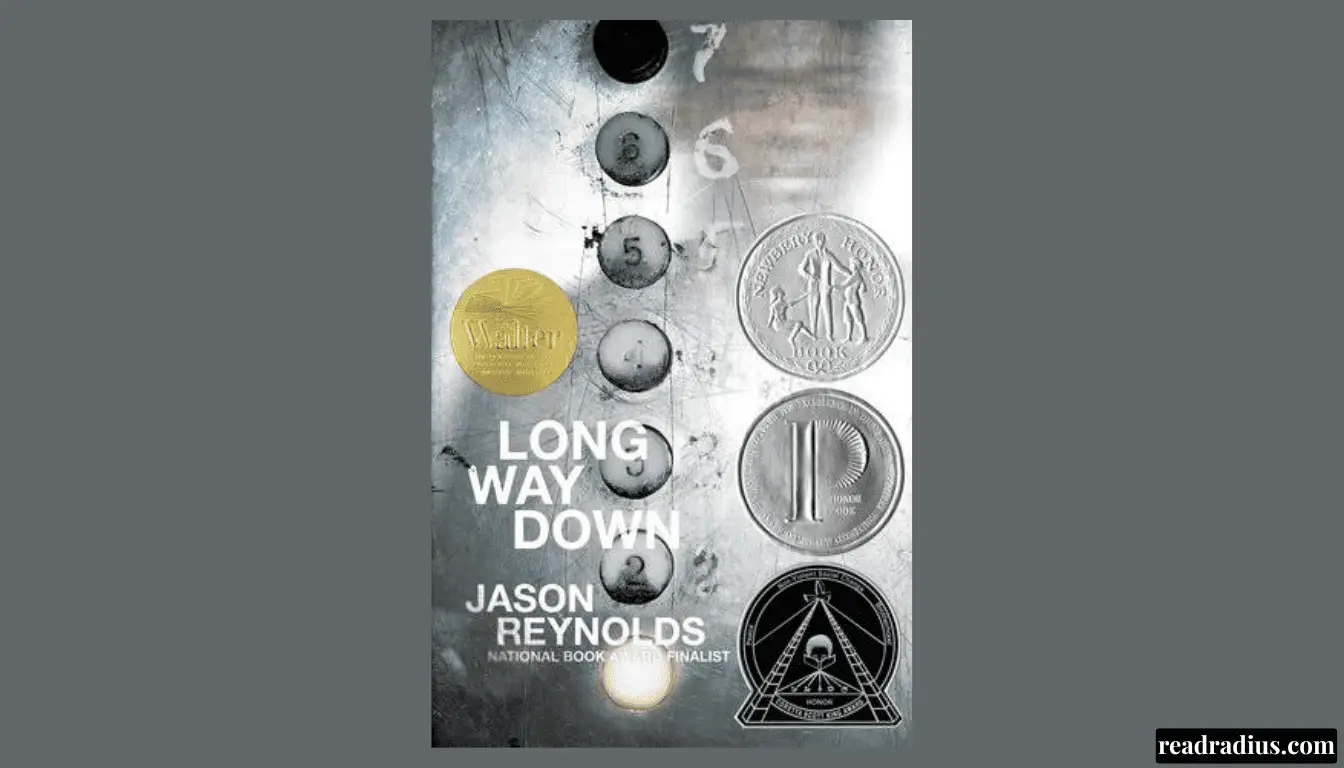
There’s a certain kind of book that a reader finishes in under an hour and then thinks about for weeks. Long Way Down by Jason Reynolds is exactly that kind of book. It’s short, it’s written in verse, and it takes place almost entirely inside a single elevator yet it manages to say more about grief, family, and the weight of unwritten rules than most 400-page novels ever attempt. This review breaks down the story, its themes, how readers have rated it, and why it’s earned a permanent spot on so many must-read lists for teens and adults alike.
Long Way Down Book Review by Jason Reynolds: What It’s Actually About
At its core, this is a book review of Long Way Down by Jason Reynolds, a novel-in-verse published in 2017 that was a finalist for the National Book Award. The story follows fifteen-year-old Will, whose older brother Shawn has just been shot and killed. Will knows “the rules” of his neighborhood: no crying, no snitching, and get revenge. So he takes his brother’s gun, gets on the elevator of his apartment building, and heads down to do exactly that.
What happens over the next sixty seconds because the entire book unfolds in that single elevator ride is where the story becomes something extraordinary. At each floor, a ghost from Will’s past steps in: people lost to the same cycle of violence he’s about to continue. Each visitor adds a new layer to the truth Will thought he understood, until the elevator doors open on a final, gut-punch decision left entirely to the reader’s imagination.
Long Way Down Book Synopsis, Broken Down Simply
For anyone who wants the long way down book synopsis without spoilers, here’s the shape of it:
- Setup: Will’s brother Shawn is murdered. Will decides to follow the neighborhood’s unspoken code and retaliate.
- The elevator: Over roughly sixty seconds and seven floors, ghosts from Will’s life board the elevator one by one.
- The reveal: Each ghost carries a piece of the truth about Shawn’s death and the chain of violence that led to it.
- The ending: Ambiguous by design. Reynolds leaves Will’s final choice unanswered, forcing readers to sit with the weight of the decision themselves.
That structure is part of what makes the book so re-readable. A second pass reveals details in the verse that felt like throwaway lines the first time around but turn out to matter enormously.
Long Way Down Book Explained: Why the Verse Format Works
Anyone trying to get the Long Way Down book explained in plain terms should start with the format itself, because it’s not a stylistic gimmick it’s the engine of the story. Reynolds writes in short, clipped lines of free verse rather than traditional prose paragraphs. That choice does three things at once:
- It mirrors Will’s racing mind. Short lines create urgency, the same urgency Will feels as the elevator ticks down floor by floor.
- It makes heavy subject matter accessible. Grief, cycles of violence, and moral pressure are difficult topics, but the sparse verse never feels like a lecture. It reads more like a held breath than a sermon.
- It rewards close reading. Line breaks land on words that matter. A single word sitting alone on a page can carry as much weight as a full paragraph would in a conventional novel.
Having read this one both as a personal pick and recommended it to reluctant readers over the years, the format is genuinely what converts skeptics. Teens who say they “don’t like reading” often finish this one in a single sitting, because the pacing simply doesn’t let them put it down.
Long Way Review: Themes That Stick With You
Trimmed down to a quick long way review, the themes worth highlighting are:
- Generational trauma — how violence passes from one generation to the next when no one interrupts the pattern.
- Masculinity and silence — the pressure on young men to suppress grief and respond with retaliation instead.
- Moral ambiguity — the book refuses to hand readers a tidy lesson, which is precisely what makes classroom and book-club discussions around it so rich.
It’s a book that works just as well for a quiet solo read as it does for a group discussion, which is part of why it shows up so often on school reading lists alongside contemporary YA fiction.
Long Way Down Book Rating: What Readers and Critics Say
On the long way down goodreads page, the novel consistently sits above a 4.3 out of 5 average across hundreds of thousands of ratings, with readers frequently praising how much emotional impact the book packs into so few pages. Critically, it was a finalist for the 2017 National Book Award for Young People’s Literature and later adapted into a graphic novel illustrated by Danica Novgorodoff, which introduced the story to an entirely new group of visual-first readers.
As far as the long way down book rating goes in this review: it earns a strong 4.5 out of 5. The half-point held back isn’t a flaw in the writing it’s simply that the ambiguous ending isn’t for every reader. Those who prefer a clean resolution may find themselves wanting one more chapter. Everyone else will likely find that open ending is the whole point.
A Quick Clarification: Nick Hornby’s A Long Way Down Is a Different Book
It’s worth pausing here for anyone who landed on this page searching for a Nick Hornby A Long Way Down book review, because the similar title causes genuine mix-ups. Nick Hornby’s A Long Way Down is a 2005 adult dark-comedy novel about four strangers who meet on a rooftop on New Year’s Eve, each contemplating suicide, and end up forming an unlikely bond instead. It shares almost nothing with Jason Reynolds’ book beyond a title that overlaps by one word. Readers looking for Hornby’s British humor and multi-narrator structure should search specifically for “A Long Way Down Nick Hornby” to avoid confusion, since this review focuses on Reynolds’ verse novel.
Final Verdict: Should You Read It?
Yes — and quickly, because it won’t take long. Long Way Down earns its reputation as one of the most powerful short YA novels in recent years. It doesn’t waste a single line, it trusts its readers with a difficult ending, and it opens the door to real conversations about grief and violence without ever feeling preachy. Whether picked up for a school assignment, a book club, or simply out of curiosity, it’s a book that rewards the short time it asks for.
For readers who enjoyed the graphic novel adaptation of Long Way Down and want more visual storytelling with real emotional depth, this guide is worth a look: YA Graphic Novels: The Ultimate Guide to the Best Graphic Novel Books for Teens and Adults.

Leave a Reply