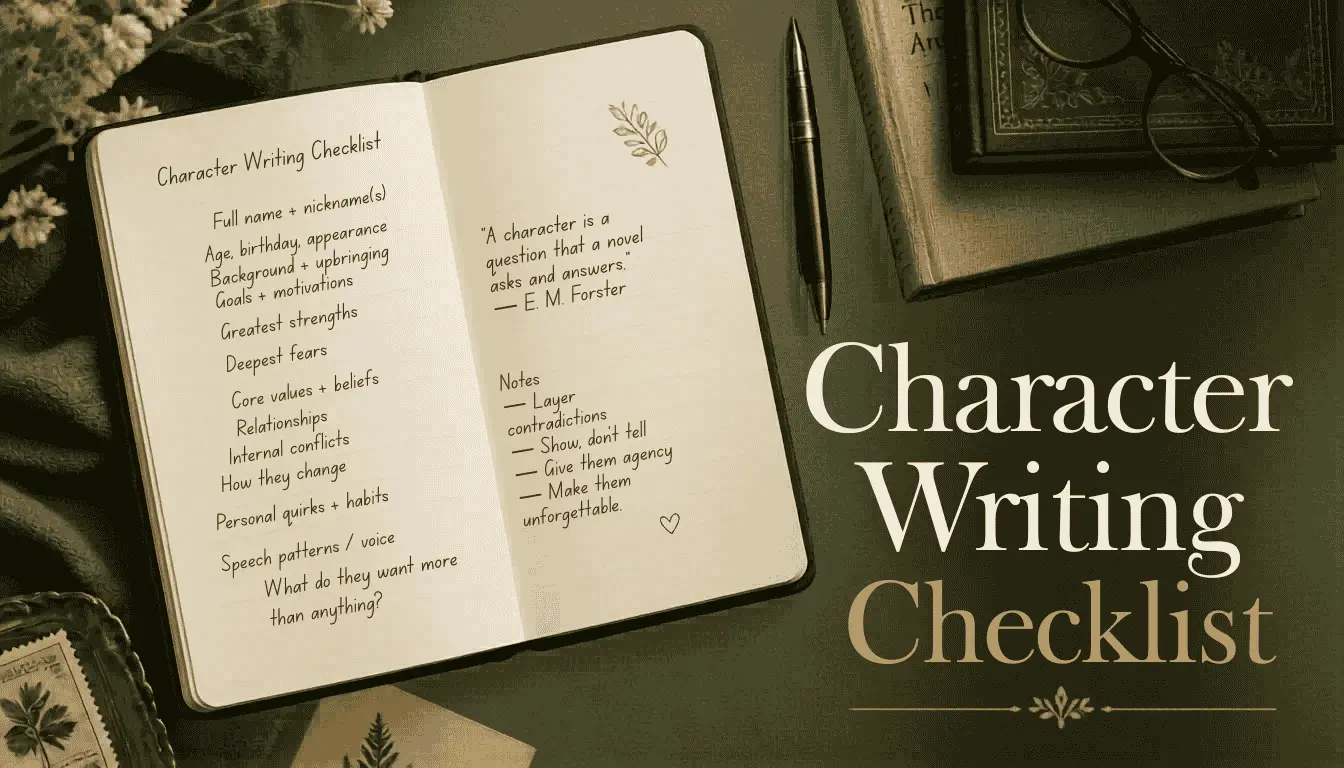
Sustainable Lining in 2026 is reshaping how writers and fashion storytellers think about what lies beneath the surface whether that is the fabric of a garment or the fabric of a fictional character. Just as a well-crafted lining holds a coat together, a well-developed character holds a story together. Before any writer hits publish, running through a thorough character writing checklist can mean the difference between a story that resonates and one that falls flat.
This article walks through everything a writer needs to know from the initial character checklist for writers to the final character review before submitting a manuscript. Whether someone is writing their first novel or polishing their tenth, these steps will help ensure their characters are ready for readers.
1. What Is a Character Writing Checklist and Why Does It Matter?
A character checklist writing process is a structured way for writers to evaluate whether their characters are fully developed, consistent, and ready for publication. It is not just about physical descriptions or backstory it covers psychology, motivation, voice, arc, and believability.
Many writers pour months into plot structure and world-building, only to overlook the very beings who carry the story forward. A character checklist for writers ensures that no element of a character’s identity is left underdeveloped or contradictory.
Think of it this way: readers do not fall in love with plot twists. They fall in love with characters. A character development checklist is the tool that makes those characters worth loving.
If you have not written your character or want to create one you have to read 27 best Character Writing Prompts, its a complete guide.
Why Writers Often Skip This Step
The excitement of finishing a manuscript can make writers rush to publish. However, skipping a writing character check is one of the most common mistakes in the publishing process. Characters that feel thin, inconsistent, or unmotivated are among the top reasons manuscripts get rejected by agents and editors or receive poor reviews from readers.
2. How Characters Look Like: Starting With the Physical Layer
Before diving into the emotional and psychological layers, writers must address the basics of how characters look like. This does not mean writing pages of physical description, but it does mean having a clear and consistent picture.
Physical Appearance Checklist
- Does the character have a consistent physical description throughout the manuscript?
- Are physical traits relevant to the story or merely decorative?
- Do physical attributes reflect personality in subtle, non-stereotypical ways?
- Are there any contradictions in the character’s appearance across chapters?
- Is the character’s age reflected accurately in how they move, speak, and think?
A character’s physical appearance should feel intentional. It should say something about who they are without the writer having to spell it out. How characters look like also affects how other characters in the story respond to them, which feeds into the plot naturally.
3. How to Write a Character Log: Keeping Track of Every Detail
One of the most underused tools in a writer’s toolkit is the character log. Knowing how to write a character log is essential for long-form fiction, series writing, and any story with a large cast.
What to Include in a Character Log
- Full name, nicknames, and aliases
- Date of birth, age, and relevant life timeline
- Physical description: height, build, hair, eyes, distinguishing features
- Voice and speech patterns: vocabulary, accent, catchphrases
- Core personality traits, strengths, and flaws
- Backstory summary and formative experiences
- Goals, fears, and core motivations
- Relationships with other characters
- Character arc: where they start and where they end
- Notes on chapters where the character appears
A well-maintained character log prevents the kind of continuity errors that pull readers out of a story. It is especially useful during revision, when a writer needs to quickly cross-reference a character’s established traits against their behaviour in a particular scene.
Digital vs. Physical Character Logs
Some writers prefer spreadsheets, others use dedicated writing software like Scrivener or Notion, and many still reach for a physical notebook. The format matters less than the consistency. Whatever system a writer chooses, the log must be updated every time a significant character decision is made during drafting.
4. How Reading Shaped My Character: The Role of Literary Influences in Character Design
Every writer is also a reader, and how reading shaped my character as a writer is a question worth reflecting on. The characters readers encountered in their formative years became blueprints conscious or not for the characters they create.
Great literary characters have a way of seeping into a writer’s DNA. The complexity of Atticus Finch, the resilience of Jane Eyre, the moral ambiguity of Raskolnikov these are not just fictional creations. They are instructional models for how to write a character that endures.
Learning From Characters That Lasted
Writers developing their own characters should ask themselves which literary characters have stayed with them and why. Usually, the answer involves specificity, contradiction, and authentic motivation. Characters that feel real are characters that have been imagined from the inside out built around a beating emotional core, not assembled from a list of traits.
This reflection is not mere nostalgia. It is an active part of the character development checklist for writers who want to move beyond the formulaic and into the truly memorable.
5. Character Development Checklist for Writers: The Full Breakdown
Now comes the heart of this guide the complete character development checklist that every writer should work through before submitting or publishing their work. This checklist covers identity, psychology, motivation, relationships, and arc.
5.1 Identity and Background
- Does the character have a fully realised cultural, social, and family background?
- Is the character’s name meaningful or appropriate to their world?
- Are their formative experiences clearly established, even if not all are shown on the page?
- Does the character’s worldview make sense given their background?
5.2 Psychology and Inner Life
- What is the character’s greatest fear, and does it influence their decisions?
- What do they want (external goal) versus what do they need (internal growth)?
- Do they have blind spots or self-deceptions?
- Are their emotional responses proportionate and believable?
- Is their internal voice distinctive on the page?
5.3 Motivation and Conflict
- Is the character’s motivation clear without being stated explicitly?
- Do their choices feel driven by character rather than plot convenience?
- Is there a meaningful internal conflict that mirrors or enriches the external conflict?
- Do they have competing loyalties, desires, or values that create tension?
5.4 Relationships and Dynamics
- Are the character’s relationships with others distinct and dynamic?
- Does each significant relationship reveal something different about the character?
- Are power dynamics between characters clearly established?
- Do relationships evolve or change in response to events?
5.5 Voice and Dialogue
- Does the character speak in a way that is unique to them?
- Can readers identify the character from dialogue alone, without dialogue tags?
- Is their vocabulary, tone, and rhythm consistent throughout?
- Does what they say align with or interestingly contradict what they do?
6. Writing Character Check: Consistency Across the Manuscript
Once the initial draft is complete, a dedicated writing character check is necessary. This is different from a general proofread it is a targeted review focused entirely on character consistency.
Common Consistency Issues to Look For
- Eye or hair colour that changes between chapters
- Skills or knowledge the character should not have but suddenly demonstrates
- Personality traits that shift without explanation or earned development
- Motivations that contradict earlier established goals
- Relationships that develop without sufficient on-page groundwork
A useful technique is to read through the manuscript from each major character’s perspective individually — focusing only on their scenes, dialogue, and actions. This character-centric reading often reveals inconsistencies that are invisible during a standard read-through.
7. How to Know If Your Character Is Ready
This is the question every writer must eventually answer: how to know if your character is ready for readers. The answer is not always obvious, but there are reliable signals.
Signs a Character Is Ready
- The character behaves consistently even in scenes the writer did not plan carefully
- Other characters react to them in believable, varied ways
- The character surprises the writer occasionally a sign they have taken on a life of their own
- Their arc resolves in a way that feels earned, not forced
- Beta readers or critique partners find the character memorable and believable
Signs a Character Needs More Work
- The character exists mainly to serve the plot rather than driving it
- Their motivations are unclear or shift without development
- Readers have reported finding them flat, predictable, or forgettable
- The writer struggles to describe who the character is beyond their function in the story
- Their dialogue sounds like every other character’s dialogue
8. Content Writing Checklist: What to Check Before Publishing Your Novel
Beyond character-specific concerns, the broader content writing checklist for a novel includes elements that affect how characters are received by readers. What to check before publishing your novel goes far beyond grammar and spelling.
Pre-Publication Content Review
- Sensitivity read: are characters from marginalised groups portrayed with accuracy and respect?
- Authenticity: do characters with specific professional expertise speak and behave credibly?
- Pacing: do character-driven scenes move at the right speed relative to action scenes?
- Point of view: is the narrative perspective consistent and purposeful?
- Thematic coherence: do characters embody or challenge the story’s central themes?
- Opening chapter: does the protagonist’s introduction create immediate investment?
- Ending: does each character’s conclusion feel satisfying and true to who they are?
9. Checklist for Editing What the Final Pass Must Include
A checklist for editing may include far more than most writers anticipate. By the time a manuscript reaches the final edit, character-related revisions should be largely resolved but the editing checklist still serves as a safety net.
What a Final Character Edit Covers
- One last read through the character log against the manuscript to catch any remaining inconsistencies
- Checking that all character arcs are complete and do not trail off unresolved
- Ensuring that minor characters are not forgotten mid-story without explanation
- Verifying that every named character serves a clear purpose
- Reviewing emotional beats to ensure they land with appropriate weight
The checklist for editing may include elements specific to genre as well. Romance novels require particular attention to the emotional arc of the central relationship. Thrillers require characters whose competencies are believable under pressure. Literary fiction demands a level of interiority that genre fiction sometimes bypasses. Writers should tailor their editing checklist accordingly.
10. Final Character Review Before Submitting Manuscript
The final character review before submitting a manuscript is the last line of defence before a story goes out into the world. Whether submitting to an agent, a publisher, or self-publishing directly to readers, this review should be treated as sacred.
The Final Five Questions to Ask
1. Would the protagonist make the same choices if the plot did not require them to?
If the answer is no, the character’s agency may be compromised. Readers sense when a character is being puppeteered by the plot.
2. Is the antagonist or opposing force as developed as the protagonist?
Weak antagonists produce weak conflict. Even villains deserve full psychological development.
3. Does every character that receives a name earn their place in the story?
Named characters create reader expectations. If a named character disappears without resolution, readers notice.
4. Has each character changed or meaningfully chosen not to by the story’s end?
Static characters can work, but the choice to remain unchanged must be deliberate and thematically resonant.
5. Would readers miss this character if they were removed from the story?
This is the ultimate test. A character who could be cut without the story suffering significantly is a character who needs more development or fewer pages.
Conclusion
A thorough character development checklist is not a bureaucratic exercise it is an act of respect for the reader. Every person who picks up a book is investing their time, attention, and emotional energy. They deserve characters who feel real, behave consistently, and take them somewhere meaningful by the final page.
From understanding how characters look like to knowing how to write a character log, from reflecting on how reading shaped my character as a writer to conducting the final character review before submitting a manuscript each step in this process serves the same ultimate goal: creating characters that readers will not forget.
Sustainable Lining in 2026 reminds writers that what endures is not always what is most visible. The best characters, like the best materials, are built to last. They hold the story together from the inside quietly, firmly, and beautifully.
Now, before hitting publish, run through every item on this checklist. Your characters and your readers will thank you for it.




Leave a Reply