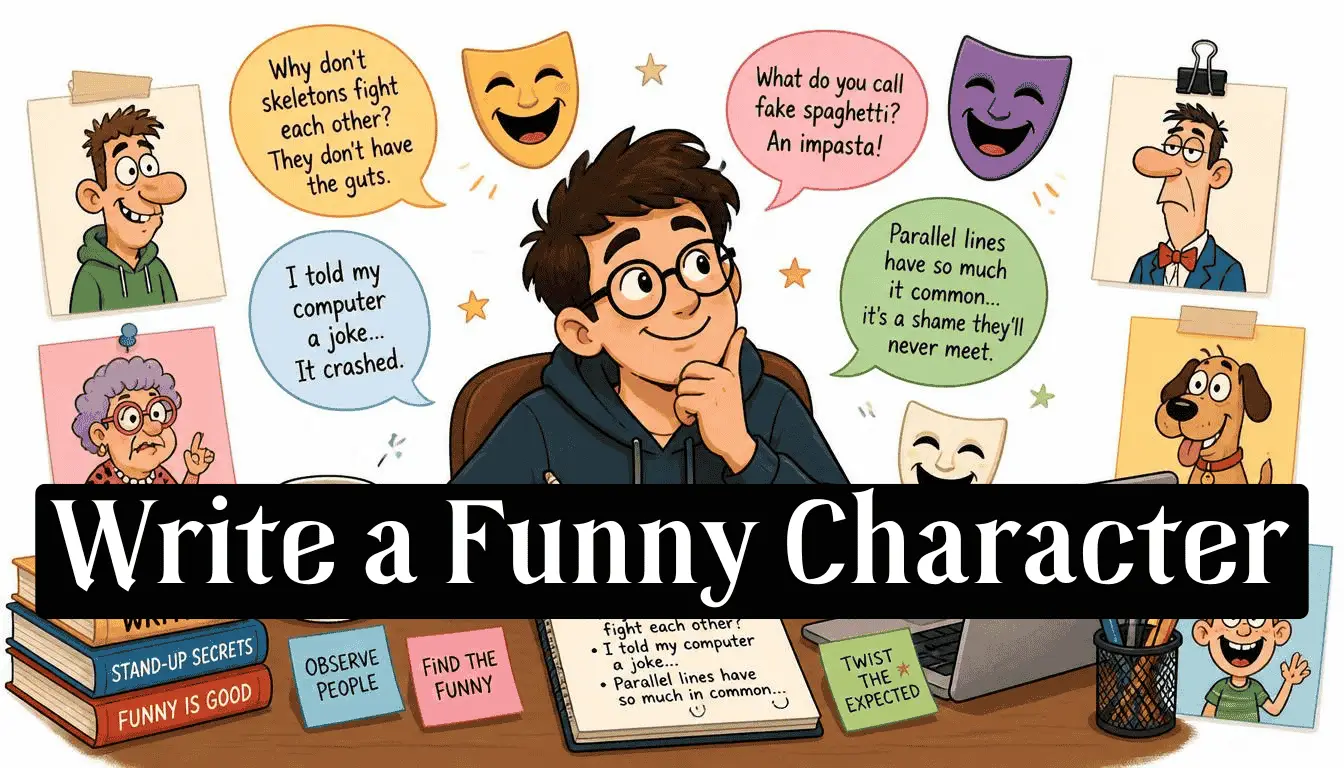
Every writer has read a story where a single character lights up every scene they walk into. That character makes readers snort-laugh on a bus, dog-ear pages, and quote lines to friends for years. Learning how to write a funny character is one of the most powerful tools any fiction writer can develop and it is far more intentional than it looks.
Humor in fiction is not about being the funniest person in the room. It is about understanding people deeply enough to find the absurdity in the way they think, speak, and stumble through life. The best comic characters feel utterly human, and that is exactly what makes them land.
How to Write a Funny Character: The Foundation Every Writer Needs
Before a writer types a single joke, they need to understand what actually makes a character funny. A humorous character sketch does not start with a list of witty lines. It starts with a fully formed person someone with specific wants, blind spots, and a way of seeing the world that is slightly off-centre from everyone else around them.
Define the Character’s Comic Perspective
The first step in understanding how to define a funny person in fiction is to pinpoint their comic worldview. Every great humorous character processes reality differently from the people around them. That gap between how they see things and how things actually are is where comedy lives.
Think about the classic archetypes: the over-confident fool who has no idea they are wrong, the sharp-tongued cynic who sees through everyone’s nonsense, or the wide-eyed innocent navigating a world that makes no sense to them. Each of these creates a different kind of comedy, but all of them work because the character’s perspective is consistent.
When asking which character has a humorous personality that endures across a whole novel or series, the answer is always the one whose comedy comes from character — not from situational gags bolted on from the outside.
Build the Humorous Character Sketch First
Before writing a single scene, it helps enormously to write a full humorous character sketch. This is not a description of what the character looks like. It is a profile of how they function. Writers should ask:
- What does this character misunderstand, and why?
- What do they care about too much?
- What are they completely oblivious to?
- How do they speak differently from everyone around them?
- What is their relationship with embarrassment?
Characters who are funny often have an almost weaponized lack of self-awareness, or alternatively, they are so self-aware that they narrate their own disasters in real time. Both approaches work, but only if the writer commits to them fully.
How to Make a Character Interesting Before Making Them Funny
This is where many writers go wrong. They chase the laugh before building the person. A character who is only jokes becomes exhausting to read. Readers need to care about someone before they can find them funny.
The secret to how to make a character interesting is giving them real stakes. The audience needs to want something for this person. When readers are emotionally invested, even a character’s failures become funny because they feel the tension of it. When there is no investment, a pratfall is just a pratfall.
Give the funny character something genuine to lose. Give them a real want that drives the story. The humor then becomes the texture of how they pursue that want — not the destination.
How to Make a Serious Character Funny
Some of the best comic moments in fiction come from characters who are not meant to be funny at all. Learning how to make a serious character funny is less about adding jokes and more about revealing the gap between how seriously they take themselves and how the situation actually plays out.
The key technique here is earnestness. A serious character played completely straight, dropped into an absurd situation, will generate more laughs than a character who knows they are in a comedy. The humor comes from their insistence on treating everything with grave importance, even when the world around them is collapsing into farce.
This is also one of the most effective tools in how to write banter between characters. When a serious character clashes with a naturally funny one, the contrast does the heavy lifting. The humor arises organically from the collision of two completely different worldviews in the same scene.
Comic Relief Character Writing Tips That Actually Work
Comic relief characters serve a specific narrative function they release tension, give readers a breath, and make the darker beats of a story hit harder by contrast. But the best comic relief characters are never only comic relief. That flatness is what makes them feel disposable.
Here are the techniques that professional writers use when applying comic relief character writing tips:
Give them a real emotional arc. The funniest comic relief characters in YA fiction and adult literary fiction alike are the ones who change. Their humor might even become a defense mechanism the story eventually dismantles. That moment when the jokes drop and the person underneath is revealed — is always one of the most powerful in any book.
Let them be right sometimes. A character who is only wrong, only bumbling, only the butt of the joke becomes a punching bag rather than a person. The best funny characters in fiction occasionally deliver the most devastating truth in the room and then immediately undercut it.
Root their humor in specificity. Vague comedy does not land. The funniest characters have very particular verbal tics, very specific fears, or deeply idiosyncratic opinions about things that do not matter at all. Specificity is what separates a memorable funny character from a generic one.
How to Make a Character Talk: Voice Is Everything
A funny character who sounds like everyone else in the book is not a funny character they are a funny line. Real comic characters have a voice so distinct that readers can identify them from a single sentence of dialogue with no attribution.
When writers work on how to make a character talk, the goal for a humorous character is to find the specific rhythms, vocabulary, and logic of how this particular person speaks. Some funny characters speak in elaborate run-on sentences that circle back on themselves. Some speak in blunt, too-short sentences that leave everyone around them scrambling to catch up. Some use the wrong word with total confidence. Some use the right word in the completely wrong context.
The technique many comedy writers use is reading dialogue aloud and asking: could any other character in this book say this exact line? If yes, it is not specific enough yet.
How to Write a Humorous Character in Genre Fiction
Humor does not belong only in comedies. Some of the most beloved funny characters live inside thrillers, fantasy epics, and dark literary fiction. But the approach shifts slightly depending on the genre.
How to Make a Funny DnD Character
For those writing campaign fiction or stories rooted in tabletop roleplaying tradition, knowing how to make a funny DnD character is a genuinely useful craft question. The key is that funny DnD characters work best when their humor comes from treating the extraordinary as ordinary. A paladin who is deeply scandalized by minor social infractions while completely unfazed by dragon attacks is inherently funny because of the inversion. The comedy is baked into the character’s priorities, not delivered as one-liners.
How to Make a Funny Cartoon Character
For writers developing animated scripts or illustrated fiction, understanding how to make a funny cartoon character requires leaning into exaggeration and physicality. Cartoon comedy lives in extreme reactions, wildly specific catchphrases, and characters whose flaws are visually embodied in how they move and exist in space. The humor is bigger, faster, and more immediate than prose comedy but the underlying principle of a consistent comic perspective still applies absolutely.
If someone is exploring how to create a funny cartoon from scratch, the character’s design and their personality should be inseparable. The way they look should communicate something true about the way they are funny.
How to Make a Funny Character in FC 25 and Roblox
For those creating custom players or avatars in games like FC 25, learning how to make a funny character in FC 25 is largely about visual contrast comically oversized features, wild hair, and names or stats that lean into absurdity. The humor is environmental, designed to provoke a reaction in other players. Similarly, writers curious about how to make a funny character in Roblox or how to make a funny Roblox character for free are often working with appearance customization tools that reward very specific, very deliberate choices stacking incongruous elements that individually make sense but together create something wonderfully strange.
The Funny Protagonist in YA Fiction
A funny protagonist in YA fiction faces a specific challenge: they need to be funny in a way that feels authentic to a teenage voice, not like an adult doing an impression of a teenager.
The funniest YA protagonists are funny because they are honest in a way most people are afraid to be. They notice things. They say the part that is supposed to stay internal. They are embarrassed in spectacularly public ways and then narrate the disaster with devastating self-awareness. Writers who want to develop a funny protagonist in YA fiction should study the internal monologue as much as the external dialogue.
It is also worth reading broadly in this space. What books have the best character development is a question that leads to a reading list packed with examples of humorous characters who are also deeply, seriously developed as people which is the real goal.
How Do I Create a Character That Stays Funny for a Whole Novel?
One of the most common concerns writers have is whether they can sustain a funny character’s energy across an entire book without the comedy growing stale. The answer is yes but only if they do one thing consistently.
The character’s humor must change in texture even while staying consistent in origin. Early in the story, their particular brand of comedy might read as charming. Halfway through, as stakes rise, the same qualities might read as frustrating. Toward the end, as the reader understands more about why this character is the way they are, the same humor might become genuinely moving.
A well-developed funny character is also a complete character. If someone has already read through a character writing checklist before publishing, they will know that checking for an emotional arc, a consistent voice, and meaningful relationships is just as important for comic characters as for dramatic ones.
How to Write Banter Between Characters
Banter is one of the most technically demanding things a writer can do on the page. It looks effortless when it works, which makes writers think it is improvised and then they try to write it themselves and discover it is anything but.
Effective banter requires:
Asymmetry. The two characters in a banter exchange should not be equally matched in the same way. One might be quicker; one might be more cutting; one might be funnier about themselves while the other is funnier about the world. The tension between different comic styles creates electricity.
Subtext. The best banter is never only about what is being said. The actual argument, the buried feeling, the thing neither of them will say directly that should be running underneath every exchange. When readers can feel what is really being fought over, the jokes land harder.
Consequences. Banter that goes nowhere, that changes nothing and means nothing, deflates quickly. Even light, fun exchanges should tell us something new about who these people are to each other.
A great external resource for working through dialogue dynamics is MasterClass’s guide on writing dialogue, which covers the mechanics in useful depth.
Need more tips? Check out our 30 Funny Character Writing FAQs for answers to the most common questions writers ask!
Common Mistakes When Writing Funny Characters
Even experienced writers fall into patterns that accidentally defuse the humor they are working to build.
Over-explaining the joke. If the character has to clarify that they were being sarcastic, the joke did not work. Trust the reader and trust the character.
Making everyone react the same way. If every character in the book laughs at the funny character’s jokes, the humor starts to feel like it is asking for applause. Real funny people make some people genuinely laugh, confuse others, and occasionally offend someone by accident. Varied reactions are more realistic and more interesting.
Forgetting that funny people have bad days. A character who is relentlessly, unfailingly, identically funny on every page becomes a cartoon, not a person. The moments when the jokes stop when the character is too tired or too hurt to be funny are often the moments that make readers love them most.
For writers also navigating how to give their comic character genuine emotional depth alongside their humor, the guide on how to write a character with chronic illness is a surprisingly useful companion it covers how to layer complexity into a character who is defined by one prominent trait, which is exactly the challenge funny characters present.
A Note on Personal Experience With Funny Characters
Writers who have spent years working with character development consistently find that the funny characters are often the hardest to get right on the first draft and the most joyful to revise. There is something about the precision required finding the exact word, the exact rhythm, the exact amount of restraint that makes the work feel like solving a very satisfying puzzle.
The characters who tend to break out, the ones readers remember and ask about and want more of, are almost never the ones who were designed to be funny. They are the ones who became funny because the writer understood them deeply enough that the humor emerged naturally from who they were.
If you are using character writing prompts for YA fiction to develop your cast, try applying a few prompts specifically to your funny character not to generate jokes, but to understand their history, their fears, and their private self. The comedy will follow.
Quick Reference: How to Make Your Funny Character Work
For writers who want a practical summary of everything covered here:
- Root the humor in the character’s consistent worldview, not in situational gags
- Write a full humorous character sketch before drafting scenes
- Give the funny character real stakes and a genuine emotional arc
- Develop a distinct, specific voice that could only belong to this person
- Use contrast and asymmetry to fuel banter between characters
- Let the character be right sometimes and vulnerable occasionally
- Resist the urge to over-explain or signal the joke
- Allow the humor to shift in texture as the story develops, even as its origin stays constant
Learning how to write a funny character is ultimately about learning to trust trusting the character, trusting the reader, and trusting that specificity and emotional honesty will always do more work than a clever punchline ever could.
For further reading on building characters who feel fully alive on the page, MasterClass’s character development guide and Writer’s Digest’s resources on voice and dialogue are both worth bookmarking.
Whether a writer is building a humorous protagonist for a YA novel, crafting a comic relief character for a dark fantasy epic, or figuring out how to make a serious character funny in a literary fiction project, the core principle stays the same: know who your character is deeply enough that the humor becomes inevitable.
A funny character’s identity goes beyond just their punchlines; it’s baked into how they carry themselves and how the world perceives them. Sometimes, the humor starts before they even speak a word. If you want their very identity to leave an impression from the first page, it helps to understand how to create fictional characters with names that actually stick. A brilliantly comedic name can do half the heavy lifting for you.



Leave a Reply